As most busy college students probably know, sleep is a precious commodity. There is always something more important to do than sleep, whether it be pulling an all-nighter studying, or staying out late partying. I've always tried to consistently get 6-7 hours of sleep a night, with the occasional "catch-up" nap, but since I have real trouble actually sleeping past 9 am, this isn't always possible.
I have been kind of sick all weekend, so last night, I took the recommended dose of NyQuil and passed out for 11 hours.
Needless to say, I felt great this morning, but it got me thinking, "why does a good night's sleep make me feel so good?" Here are some interesting facts on sleep:
- Adults who report sleeping 6-7 hours per night live longer than those who sleep more or less.
- Sleep deprivation does adversely effect the immune system, but has not been proven to stunt growth in children.
- In mammals, the amount of sleep needed is generally inversely related to size (rats sleep 14 hours per day, while elephants sleep 3-4).
- Despite popular belief, tryptophan has not been linked to changes in sleep patterns. Turkey does not magically make you tired, but overeating and certain times of the day do.
- Your body experiences a natural dip in alertness at both 2am and 2pm.
- REM sleep is important in brain growth and maturity. Deprivation in REM sleep can lead to behavioral and psychological problems
- Drinking alcohol may make you feel sleepy by causing somnolence, but it reduces the amount of REM sleep that you get.
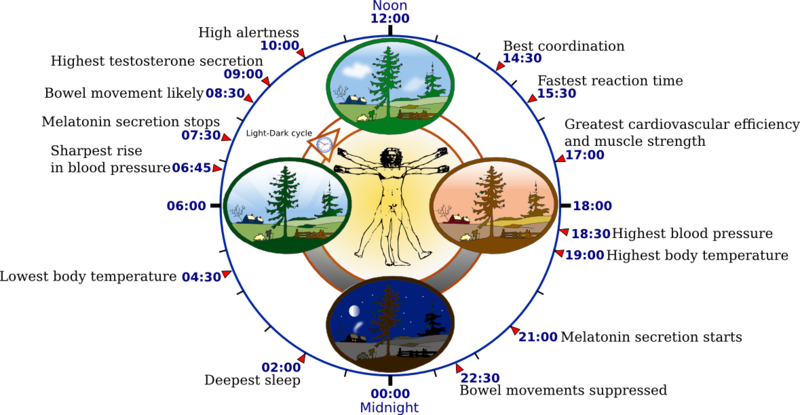
Courtesy of Wikipedia
Showing posts with label humans. Show all posts
August 30, 2010
August 18, 2010
The End of Humans, the Rise of Bacteria
Very few thinking people are naive enough to believe that humans will remain the dominant species on this earth forever. "Forever" is a long time. I'm sure that if dinosaurs possessed the level of cognitive thinking that humans do, they would have thought they were going to live forever too. Of course, dinosaurs are a whole grouping of various species that are somewhere between birds and reptiles, but they roamed the earth for 165 million years. Mammals have only been a dominant species for the better part of the last 60 million years, so should we be looking for the downfall of mammals anytime soon?
Provided a drastic change in climate or other unforeseen disaster occurs, probably not, but the human species? That's a whole different question. I don't buy into scare tactics by the media or even scientists. It's too hard to tell who's got an agenda these days, but I do believe that in some ways, our modern medicine is both saving and destroying our species.
Curious Cat Science and Engineering Blog is one of my favorite weekly reads (despite it's late 90's website design format). Check out his newest article on the end of antibiotics and potentially the end of humans:
http://engineering.curiouscatblog.net/2010/08/15/are-you-ready-for-a-world-without-antibiotics/
Provided a drastic change in climate or other unforeseen disaster occurs, probably not, but the human species? That's a whole different question. I don't buy into scare tactics by the media or even scientists. It's too hard to tell who's got an agenda these days, but I do believe that in some ways, our modern medicine is both saving and destroying our species.
Curious Cat Science and Engineering Blog is one of my favorite weekly reads (despite it's late 90's website design format). Check out his newest article on the end of antibiotics and potentially the end of humans:
http://engineering.curiouscatblog.net/2010/08/15/are-you-ready-for-a-world-without-antibiotics/
June 4, 2010
Yes, I would like to live forever, thank you very much!
For all those who say they don't want to have a computer implanted inside of them, I bet that will change when it can save your life:
Do You Want to Live Forever?
May 21, 2010
Women in Engineering
I found an interesting study while cruising the internet today, and although it was written in 1995, I think it still holds true today for the most part:
http://www4.ncsu.edu/unity/lockers/users/f/felder/public/Papers/long3.pdf
In case you don't have half an hour to read through this, I'll summarize. The study compares men and women in Chemical Engineering at NC State. The goal was to shed light on the low numbers of women who become interested in engineering both in college and at the professional level. It has been suggested that this is due to natural abilities that men possess over women in the past, but this study does a pretty good job eliminating that factor. The conclusion that the author reaches is that women tend to shy away from engineering for a variety of reasons, but most are tied to their confidence. Women in engineering (as compared to men) tend to have lower confidence in both their natural ability and academic preparedness. The study also made a good point in that women tend to be ignored or interrupted more in group settings (a focus of this study). Another interesting statistic that this study brought to my attention is that around 20% of engineering students (men and women) believe it is too demanding to combine with family responsibilities.
I tend to agree with a lot of what this study concluded. First, I don't think that women avoid education or careers in math and engineering because they are not as qualified as men or because they are naturally less intelligent. I believe the reason is for more societal. Women are not brought up the same way as men in our culture. We tend to raise boys to compete and build things and be in charge, and girls to be dainty and pretty.
The problem with this tendency is that it repeats itself generationally. Daughters usually identify with their mother, and usually emulate them at some level. The study also showed that women beginning the engineering program were much more likely to have two parents who finished college than the men were. To compound the problem, there are very few women who teach engineering on the college level, and this can leave a real lack of suitable role models for college-aged women.
As the article suggests, there are some proposed solutions for the disparity of women in the industry, but I won't get into much detail there. I would like to say though, that men in engineering have a duty to respect and encourage our female counterparts (just like they would respect and encourage fellow males). I have seen how prevalent sexism can be among small groups of male engineers, and while some jokes may be appropriate, sexist jokes or real sexist discrimination is not appropriate or professional.
http://www4.ncsu.edu/unity/lockers/users/f/felder/public/Papers/long3.pdf
In case you don't have half an hour to read through this, I'll summarize. The study compares men and women in Chemical Engineering at NC State. The goal was to shed light on the low numbers of women who become interested in engineering both in college and at the professional level. It has been suggested that this is due to natural abilities that men possess over women in the past, but this study does a pretty good job eliminating that factor. The conclusion that the author reaches is that women tend to shy away from engineering for a variety of reasons, but most are tied to their confidence. Women in engineering (as compared to men) tend to have lower confidence in both their natural ability and academic preparedness. The study also made a good point in that women tend to be ignored or interrupted more in group settings (a focus of this study). Another interesting statistic that this study brought to my attention is that around 20% of engineering students (men and women) believe it is too demanding to combine with family responsibilities.
I tend to agree with a lot of what this study concluded. First, I don't think that women avoid education or careers in math and engineering because they are not as qualified as men or because they are naturally less intelligent. I believe the reason is for more societal. Women are not brought up the same way as men in our culture. We tend to raise boys to compete and build things and be in charge, and girls to be dainty and pretty.
The problem with this tendency is that it repeats itself generationally. Daughters usually identify with their mother, and usually emulate them at some level. The study also showed that women beginning the engineering program were much more likely to have two parents who finished college than the men were. To compound the problem, there are very few women who teach engineering on the college level, and this can leave a real lack of suitable role models for college-aged women.
As the article suggests, there are some proposed solutions for the disparity of women in the industry, but I won't get into much detail there. I would like to say though, that men in engineering have a duty to respect and encourage our female counterparts (just like they would respect and encourage fellow males). I have seen how prevalent sexism can be among small groups of male engineers, and while some jokes may be appropriate, sexist jokes or real sexist discrimination is not appropriate or professional.
Subscribe to:
Posts (Atom)
