After about 8 months of service, I am officially leaving Blogger, but don't worry, I will continue to post regular blogs. I am in the process of starting a new project called VolBlogs, which will have several UT student contributors. I will update you all on its progress via Facebook and Twitter as I get the site finished up.
Meanwhile, if you'd like to become a contributor to VolBlogs, I am still looking for a couple more writers, so please let me know. See this site to find out how you can join us!
Thanks for reading with me, see you in a couple weeks on VolBlogs.
November 15, 2010


November 12, 2010
Another Reason to Thank Your Veterans
The military spending in our country gets a lot of attention from both ends of the political spectrum. This year, the total Defense budget in the U.S. was up 3% to $685,000,000,000.00
Yeah, that's a lot of zeros.
But, regardless of how you feel about the money we allocate to national defense, you can't deny the amazing technology that the military has given us. I just read an article about the Army's development of tooth-cleaning gum, expected to reach the private sector soon, and that may be one of the least significant advancements that the military has brought us. For example, most of the research done to make nuclear power possible was done during the Manhattan Project in World War II. The project basically created the city of Oak Ridge just outside of Knoxville, TN - the town grew to 25 times its pre-war size between 1942 and 1943 - and has allowed for continued research in many fields of science and engineering to flourish in East Tennessee. The military had a hand in the evolution and growth of the internet, GPS, jet engines, digital photography, and radar to name a few.

Due in part to the fact that the military in our country has such a large budget, they have been able to invent many significant technologies that are now in use every day in the private sector, and thanks to all the dedicated soldiers, scientists, engineers, and other creative minds in our country, I think the military will continue to churn out the newest and greatest technologies. I'm a day late for Veteran's Day, but I'd like to thank all our current and past members of the US Military for their hard work, devotion, and service to our country and advancing it on every front.
Yeah, that's a lot of zeros.
But, regardless of how you feel about the money we allocate to national defense, you can't deny the amazing technology that the military has given us. I just read an article about the Army's development of tooth-cleaning gum, expected to reach the private sector soon, and that may be one of the least significant advancements that the military has brought us. For example, most of the research done to make nuclear power possible was done during the Manhattan Project in World War II. The project basically created the city of Oak Ridge just outside of Knoxville, TN - the town grew to 25 times its pre-war size between 1942 and 1943 - and has allowed for continued research in many fields of science and engineering to flourish in East Tennessee. The military had a hand in the evolution and growth of the internet, GPS, jet engines, digital photography, and radar to name a few.

Due in part to the fact that the military in our country has such a large budget, they have been able to invent many significant technologies that are now in use every day in the private sector, and thanks to all the dedicated soldiers, scientists, engineers, and other creative minds in our country, I think the military will continue to churn out the newest and greatest technologies. I'm a day late for Veteran's Day, but I'd like to thank all our current and past members of the US Military for their hard work, devotion, and service to our country and advancing it on every front.
November 2, 2010
Election Day - Part 2
I'd like to address another issue concerning elections today as well. Young people may be generally apathetic towards voting, but there are also greater hurdles for college students to get over before they can legally vote as compared to their older counterparts.
First off, many college students register at home and must submit an absentee ballot. That would be fine except that you can't cast an absentee vote the first time you do so. You have to physically attend the polls for your first election, so a lot of students get discouraged because they would have to drive all the way back home (in the middle of the week) just to vote.
Next, voting takes much more effort and much longer than it really should. The act of casting your ballot may take 2 to 5 minutes, but there are lines, questions about which polling station you should attend, and time conflicts with class and working hours.
I think voting should be moved online personally. I voted in person today with nothing but a voter registration card. No one checked a picture ID, they simply asked me if I still lived at the same address. This seems wildly easy to lie about and I was amazed that they did not even care to look at my driver's license. Well, I did not live at the same address, so as I expected, I had to fill out some paperwork and then drive to another polling station about 8 blocks away. For people who commute 45 minutes to work every day, driving to the polls near their home must be a real chore. Of course, there's early voting, but personally I like to see the campaign all the way through before I decide on my candidate. Anyway, the rules for this process are horribly archaic and over-complicated. The process does not eliminate the possibility of fraud, it just makes it more work to get to the polls.
But, I won't complain without making at least some suggestions:
1. Why can't voting day be a national mandatory holiday? If the government expects people to show up, shouldn't they at least be allowed off work for half of the day? For students or young people working a menial job or attending class, driving to their respective polling place may be difficult if not impossible to do.
2. Voting online. I think this one will happen eventually. There is no reason to have to attend a physical polling location if they don't even check your picture ID, and this could be checked on many people's personal computers (think webcams, etc). Of course, sending sensitive voting data through the interweb scares people, so it really depends on improvements in security in the coming years.
Anyway, enough for election day, and if you made it through all that, thanks for reading!
First off, many college students register at home and must submit an absentee ballot. That would be fine except that you can't cast an absentee vote the first time you do so. You have to physically attend the polls for your first election, so a lot of students get discouraged because they would have to drive all the way back home (in the middle of the week) just to vote.
Next, voting takes much more effort and much longer than it really should. The act of casting your ballot may take 2 to 5 minutes, but there are lines, questions about which polling station you should attend, and time conflicts with class and working hours.
I think voting should be moved online personally. I voted in person today with nothing but a voter registration card. No one checked a picture ID, they simply asked me if I still lived at the same address. This seems wildly easy to lie about and I was amazed that they did not even care to look at my driver's license. Well, I did not live at the same address, so as I expected, I had to fill out some paperwork and then drive to another polling station about 8 blocks away. For people who commute 45 minutes to work every day, driving to the polls near their home must be a real chore. Of course, there's early voting, but personally I like to see the campaign all the way through before I decide on my candidate. Anyway, the rules for this process are horribly archaic and over-complicated. The process does not eliminate the possibility of fraud, it just makes it more work to get to the polls.
But, I won't complain without making at least some suggestions:
1. Why can't voting day be a national mandatory holiday? If the government expects people to show up, shouldn't they at least be allowed off work for half of the day? For students or young people working a menial job or attending class, driving to their respective polling place may be difficult if not impossible to do.
2. Voting online. I think this one will happen eventually. There is no reason to have to attend a physical polling location if they don't even check your picture ID, and this could be checked on many people's personal computers (think webcams, etc). Of course, sending sensitive voting data through the interweb scares people, so it really depends on improvements in security in the coming years.
Anyway, enough for election day, and if you made it through all that, thanks for reading!
Election Day - Part 1
Another election day has come and gone (on the East Coast at least). College kids are notoriously bad about turning out to vote, and although the 2008 Presidential Election was a record-breaking year for young voter turnout, mid-term elections are rarely attended well by people under 30 years old.
I heard plenty of excuses from my peers about why they would not be voting in today's election from "I don't know anything about the candidates" to "I just don't care because the whole system is bull s***", but neither one of those excuses are really viable.
Sure, thirty years ago you may have had to pay close attention to the news or paper to glean enough information to make an informed decision about your local representatives, but today it only takes a couple of quick Google searches to know where the candidates stand on the major issues, read about any controversies surrounding them, and find out who endorses them. I realize that college students are busy, and that political issues don't usually make it into casual conversation at the bar, but taking an hour to read about your state's potential leaders is not hard to do, and it could make a huge difference on your life. Most in-state students at UT receive a substantial scholarship from the state lottery every year, so don't assume that state politics doesn't do anything for you.
Now, to those who think that the whole system is unfair or that their vote couldn't possibly matter...I guess I'll just use a quick Kantian-style argument: What if everyone thought that way? I guess we wouldn't even have elections and we'd be thrown into anarchy. I'll admit that the system favors candidates who are more well-connected and have a stronger economic and educational background, but if more young people took the time and effort to vote, their vote would matter, so don't be part of the problem; be the solution.
I heard plenty of excuses from my peers about why they would not be voting in today's election from "I don't know anything about the candidates" to "I just don't care because the whole system is bull s***", but neither one of those excuses are really viable.
Sure, thirty years ago you may have had to pay close attention to the news or paper to glean enough information to make an informed decision about your local representatives, but today it only takes a couple of quick Google searches to know where the candidates stand on the major issues, read about any controversies surrounding them, and find out who endorses them. I realize that college students are busy, and that political issues don't usually make it into casual conversation at the bar, but taking an hour to read about your state's potential leaders is not hard to do, and it could make a huge difference on your life. Most in-state students at UT receive a substantial scholarship from the state lottery every year, so don't assume that state politics doesn't do anything for you.
Now, to those who think that the whole system is unfair or that their vote couldn't possibly matter...I guess I'll just use a quick Kantian-style argument: What if everyone thought that way? I guess we wouldn't even have elections and we'd be thrown into anarchy. I'll admit that the system favors candidates who are more well-connected and have a stronger economic and educational background, but if more young people took the time and effort to vote, their vote would matter, so don't be part of the problem; be the solution.
October 29, 2010
Update: The Internet Killswitch
I posted about Senator Joe Lieberman's attempt at putting a "Kill Switch" on the internet - or at least some parts of it - this summer, and it looks like the issue isn't dead yet.
According to an article I just read, 61% of Americans support giving the President an internet "Kill Switch" in case of a cyber attack in the future. While I agree that internet security is fast becoming an international issue as Chinese hackers have already made attacks on large American and international firms, is giving one man the power to shut down the greatest form of free communication wise?
I just think about the recent Iranian quasi-revolution that was followed by the world on Twitter, and the way that we could get a first-hand look at what was happening without a single journalist being in harm's way. This kind of instant communication is one of the greatest aspects of the internet, and putting it in jeopardy by allowing a single person to simply cut it off is - in my humble opinion - very dangerous.
 That being said, I'm sure it won't take long to figure out a way around this "Kill Switch" - if you've ever worked in an office with limited internet, you probably know at least a few people who have figured out how to get around it with a remote isp - but it could be very difficult and/or costly, not to mention legally risky.
According to an article I just read, 61% of Americans support giving the President an internet "Kill Switch" in case of a cyber attack in the future. While I agree that internet security is fast becoming an international issue as Chinese hackers have already made attacks on large American and international firms, is giving one man the power to shut down the greatest form of free communication wise?
I just think about the recent Iranian quasi-revolution that was followed by the world on Twitter, and the way that we could get a first-hand look at what was happening without a single journalist being in harm's way. This kind of instant communication is one of the greatest aspects of the internet, and putting it in jeopardy by allowing a single person to simply cut it off is - in my humble opinion - very dangerous.

October 24, 2010
Is a College Degree Still Relevant?
This semester, I have decided to do more independent learning. I am currently working my way through some heat transfer lectures on YouTube, expanding my knowledge of web-coding, and soon to begin some Python or C/C++ programming courses offered free on MIT's website. Now, I could take all these classes at UT (in fact I will have to take Heat Transfer next semester), but it has led me to ask myself, why?
As the network of free information expands online, the traditional college experience is becoming less and less relevant. UT is a very cheap school ($4,000-$5,000 per semester in state), but is this cost even necessary in order to learn the material? It's not like my tuition gives me access to some special proprietary information (at least not at the undergraduate level), and while some elements of the educational experience still currently require one's physical presence, the standard class lecture is not one of them. I can ask all the same questions that I would ask a professor on an open physics/engineering forum; I can read a free online textbook on the subject; I can watch lecture videos on my own time.
This rise of free information will soon end the traditional college lecture setting, and I think the students will benefit. Imagine going to class just once or twice a week in order to meet for group projects, do lab work, and take tests, while spending the rest of the week attending lectures online at your own pace and schedule. Being able to pause, rewind, and come back to lectures that were previously recorded is a huge advantage to having one professor for 100+ students, as he cannot possibly account for their various degrees of understanding and learning at once. This format also allows for more flexible scheduling, letting people work full-time and still be a student.
I imagine that in 5-10 years, technologies like video chat and virtualization will completely eliminate the need to physically attend a university for an undergraduate degree, allowing more people to educate themselves at a fraction of the cost and time-commitment that college now demands. The virtual classroom has advantages world-wide as internet access permeates third world and developing countries as well, and I believe there is no down-side to increasing the availability and quality of education across the globe. If we can even hope to face the challenges that the next decade will produce in overpopulation and energy consumption, we must get more of the global population thinking and working towards a solution, so take advantage of the free information that is out there, and learn a thing or two in your spare time.
As the network of free information expands online, the traditional college experience is becoming less and less relevant. UT is a very cheap school ($4,000-$5,000 per semester in state), but is this cost even necessary in order to learn the material? It's not like my tuition gives me access to some special proprietary information (at least not at the undergraduate level), and while some elements of the educational experience still currently require one's physical presence, the standard class lecture is not one of them. I can ask all the same questions that I would ask a professor on an open physics/engineering forum; I can read a free online textbook on the subject; I can watch lecture videos on my own time.
This rise of free information will soon end the traditional college lecture setting, and I think the students will benefit. Imagine going to class just once or twice a week in order to meet for group projects, do lab work, and take tests, while spending the rest of the week attending lectures online at your own pace and schedule. Being able to pause, rewind, and come back to lectures that were previously recorded is a huge advantage to having one professor for 100+ students, as he cannot possibly account for their various degrees of understanding and learning at once. This format also allows for more flexible scheduling, letting people work full-time and still be a student.
I imagine that in 5-10 years, technologies like video chat and virtualization will completely eliminate the need to physically attend a university for an undergraduate degree, allowing more people to educate themselves at a fraction of the cost and time-commitment that college now demands. The virtual classroom has advantages world-wide as internet access permeates third world and developing countries as well, and I believe there is no down-side to increasing the availability and quality of education across the globe. If we can even hope to face the challenges that the next decade will produce in overpopulation and energy consumption, we must get more of the global population thinking and working towards a solution, so take advantage of the free information that is out there, and learn a thing or two in your spare time.
October 20, 2010
Apple Buying Facebook?
It is a possibility.
http://www.theatlanticwire.com/opinions/view/opinion/The-Case-for-Apple-Buying-Facebook-5445
What would this possible merger mean for Facebook users? A lot of things, some good and some potentially bad.
1. Apple device integration - as the article points out, Apple's Facetime could receive a whole new level of users. 500 million of them worldwide. This could be the necessary step in making video chat the norm over text and phone conversations.
2. Ping integration - if you've even heard of Apple's new Ping network, you may actually use it if this buy-out becomes reality.
3. Apple gets access to huge amounts of marketing data - this is kind of the case against the merger or buyout. Apple is not in the business of information right now, and buying Facebook would give it a whole new business to run: advertising.
4. Restrictive Facebook - if you've ever used an ios device, you know how restrictive apple can be. This buyout would put Apple's closed source mentality in much closer direct competition with Google's open source services. What would these restrictions be? Well they could lead to increased privacy on Facebook, which is good, but it depends how far Apple takes it.
Is this acquisition likely? In my opinion, yes. Apple has the money, and we know Mark and Steve have met in person. If they don't buy it when Facebook goes public, they could be leaving a great opportunity open to their competition (think Google).
http://www.theatlanticwire.com/opinions/view/opinion/The-Case-for-Apple-Buying-Facebook-5445
What would this possible merger mean for Facebook users? A lot of things, some good and some potentially bad.
1. Apple device integration - as the article points out, Apple's Facetime could receive a whole new level of users. 500 million of them worldwide. This could be the necessary step in making video chat the norm over text and phone conversations.
2. Ping integration - if you've even heard of Apple's new Ping network, you may actually use it if this buy-out becomes reality.
3. Apple gets access to huge amounts of marketing data - this is kind of the case against the merger or buyout. Apple is not in the business of information right now, and buying Facebook would give it a whole new business to run: advertising.
4. Restrictive Facebook - if you've ever used an ios device, you know how restrictive apple can be. This buyout would put Apple's closed source mentality in much closer direct competition with Google's open source services. What would these restrictions be? Well they could lead to increased privacy on Facebook, which is good, but it depends how far Apple takes it.
Is this acquisition likely? In my opinion, yes. Apple has the money, and we know Mark and Steve have met in person. If they don't buy it when Facebook goes public, they could be leaving a great opportunity open to their competition (think Google).
October 15, 2010
A Novel Idea from France
Apparently, the French have decided that rather than fight illegal music piracy with costly court battles, they will subsidize young people for legally downloading music from a subscription or other music site. I wonder what the economic implications will be to the recording industry and legal system as this idea takes hold?
http://www.riaa.com/faq.php

http://www.riaa.com/faq.php
October 11, 2010
I Want to be a Miner When I Grow Up
A couple of weeks ago, I discovered a new love of mining, but not the physical labor, coal-filled air kind of mining. I discovered Minecraft.
Admittedly, the game is super-nerdy. The graphics look like they were created for an 8-bit console, and the controls, movement, and options are about as minimal as possible. That being said, it is probably the most addicting game I've played in a long time.
I've never been much of a gamer, but I do enjoy video games with a high degree of creative input from the user. The best way I've found to describe the game is a mix of Runescape circa 2002 and Lego building blocks. Your goal is simple: stay alive, but the ways that you can accomplish this goal are practically limitless.
For example, this guy built a 16-bit computer that takes input (in binary), performs one of several operations, and outputs a solution.
The "sandbox" style world which is randomly generated for the player has the potential for around 8x as much surface area as the earth, and allows the player to dig materials and minerals out of the earth in order to build or craft items that can be placed anywhere on the map. Zombies and spiders are randomly spawned from any points of darkness on the map, and the player can either build walls to keep them out, or craft weapons to fight them off as necessary. Although the game is still in Alpha testing, and the multi-player mode is pretty buggy, it shows great potential as a concept. I recommend trying it, but be careful, you could be drawn into the mines and never return.

Admittedly, the game is super-nerdy. The graphics look like they were created for an 8-bit console, and the controls, movement, and options are about as minimal as possible. That being said, it is probably the most addicting game I've played in a long time.
I've never been much of a gamer, but I do enjoy video games with a high degree of creative input from the user. The best way I've found to describe the game is a mix of Runescape circa 2002 and Lego building blocks. Your goal is simple: stay alive, but the ways that you can accomplish this goal are practically limitless.
For example, this guy built a 16-bit computer that takes input (in binary), performs one of several operations, and outputs a solution.
The "sandbox" style world which is randomly generated for the player has the potential for around 8x as much surface area as the earth, and allows the player to dig materials and minerals out of the earth in order to build or craft items that can be placed anywhere on the map. Zombies and spiders are randomly spawned from any points of darkness on the map, and the player can either build walls to keep them out, or craft weapons to fight them off as necessary. Although the game is still in Alpha testing, and the multi-player mode is pretty buggy, it shows great potential as a concept. I recommend trying it, but be careful, you could be drawn into the mines and never return.

September 24, 2010
I said GEEK, not GLEEK
AMD's VP of Marketing - Leslie Sobon - posted some thoughts on finding and holding a relationship with a geek. As a bit of a tech nerd myself, I think it's worthy of re-posting:
http://blogs.amd.com/home/2010/09/22/getageek/
Happy weekend, and maybe if you're lucky, you've got a date with a geek!
http://blogs.amd.com/home/2010/09/22/getageek/
Happy weekend, and maybe if you're lucky, you've got a date with a geek!
September 21, 2010
Get Your Hands on Education
Once again, I'm going to plug Curious Cat's Science and Engineering blog:
http://engineering.curiouscatblog.net/2010/09/18/the-diy-movement-revives-learning-by-doing/
Being a product of the homeschool system when I was younger (before 5th grade), I got a very hands on education. I was only allowed 30 minutes of electronic entertainment per day, so Legos were my primary form of entertainment and learning. In my opinion, this was a huge factor in my choice later in life to study engineering. I think it's also a reason that most kids learn technology faster now than our parents do. I also think that the government should think about this study in education reforms. Getting tangible experience with shapes and spatial reasoning could be the key to boosting the US's failing math and science scores.
http://engineering.curiouscatblog.net/2010/09/18/the-diy-movement-revives-learning-by-doing/
Being a product of the homeschool system when I was younger (before 5th grade), I got a very hands on education. I was only allowed 30 minutes of electronic entertainment per day, so Legos were my primary form of entertainment and learning. In my opinion, this was a huge factor in my choice later in life to study engineering. I think it's also a reason that most kids learn technology faster now than our parents do. I also think that the government should think about this study in education reforms. Getting tangible experience with shapes and spatial reasoning could be the key to boosting the US's failing math and science scores.
September 10, 2010
Shameless Self Promotion
I guess the whole concept of a blog is pretty self-promoting. I've tried to keep my entries interesting across the board, but I'm going to do a little shameless self promotion today and share an article that made the front page of the Daily Beacon (UT's student-led newspaper):
I guess I can't take that much credit, the hour and a half class was taught by my good friends Stephen Oi and Alex Sheinfeld, but as the Professional Development Chairman, I did most of the behind the scenes planning. Either way, this is the first time that Theta Tau has made the Daily Beacon, and definitely the first time I've made the front page!
Software tutorial helps engineers
Robbie Hargett - Staff Writer
Thursday, September 09, 2010 issue
Theta Tau, UT's professional engineering fraternity, offered a free Autodesk Inventor tutorial to engineering students Wednesday.Quoted from http://dailybeacon.utk.edu/showarticle.php?articleid=57181
Theta Tau members Alex Sheinfeld, senior in industrial engineering, and Stephen Oi, senior in electrical engineering, taught the tutorial.
"Autodesk Inventor is a program that allows the design, modeling and simulated testing of parts and assemblies in 3-D," Sheinfeld said. "This can range from one-piece parts, such as a key chain, all the way up to full, complex pieces of machinery, such as a car."
Karl Hughes, senior in mechanical engineering and Theta Tau professional development chairman, said all industrial and mechanical engineering majors at UT will use Inventor in industrial engineering 330/mechanical engineering 366 and manufacturing processes, but it is not explicitly taught in any class.
"Students are expected to teach themselves via the included tutorials, but the learning curve when starting out is pretty steep," Hughes said. "It took me several hours of tutorials plus hours of trial and error to figure out how to make a simple part."
Sheinfeld said the level of exposure to these kinds of programs in the classroom is much too low.
"The projects are mostly homework and very little time is spent in class teaching the techniques of the program," Sheinfeld said. "Furthermore it's only the very basics of the program which are covered, and it's really up to the student to take interest and try to discover more of the program on their own."
Sheinfeld said he started using Inventor in the manufacturing processes class. He said he developed an interest in the program that remained after taking the class.
"I hope (to) go a couple steps beyond what's normally taught in the classrooms to bridge the gap between learning how to make basic shapes and making the types of assemblies that we, as engineers, will be expected to make in the professional world," he said.
Hughes said Inventor and other similar programs are used frequently in the professional engineering world, and while there are many design programs other than Inventor, the skills are easily transferable.
"The advantage of this free tutorial is that every student who attends will be better equipped to face the challenges of being a professional engineer," Sheinfeld said. "The skills in this tutorial class will be very useful, not only in the context of how to use the program, but also in the context of how a product is designed."
He said he hopes students will obtain a greater appreciation for what it takes to actually make something, to "show students a more practical side of engineering than just bookwork."
"We're entering an age where every product you see, from pencils to jets, has been designed in a program like Inventor," Sheinfeld said. "This allows much greater precision in designing the product which results in more rapid prototyping, more efficient machine layouts, and an overall better and cheaper product."
Hughes said the overall goal of the tutorial was to reach out to fellow engineers, who could likely use the help.
"We will be hosting several more professional development opportunities for engineers this semester and will be working with other engineering student groups to bring guest speakers and company representatives to campus," Hughes said.
I guess I can't take that much credit, the hour and a half class was taught by my good friends Stephen Oi and Alex Sheinfeld, but as the Professional Development Chairman, I did most of the behind the scenes planning. Either way, this is the first time that Theta Tau has made the Daily Beacon, and definitely the first time I've made the front page!
September 6, 2010
Net Neutrality and the Tea Party
It looks like one of the last vestiges of truly free speech and expression may be under siege. Lately there has been a debate raging between some of the large telecoms and congress over the idea of "net neutrality". To sum the whole thing up in simple terms, Verizon and Google want to control the access speed of certain websites so that, for instance, YouTube will load faster than someone's personal home-video website. The ISP would have the power to allow bigger companies to pay them more in order to get faster connection speeds to users.
I have a fundamental problem with any sort of regulation or censorship of the Internet. I like the fact that the Internet provides (mostly) uncensored access to a wealth of information. To me, it has become one of the great equalizers in our society - allowing small companies to compete with big ones by getting equal exposure on the web for a relatively low cost. I don't know if this is going to continue if large companies are allowed to buy higher connection speeds.
Maybe this is just the way things go. As Wal-Mart kills off "mom and pop" stores, Google and other large internet companies will be able to keep the competition down on the web. Something that is interesting about this debate is the stance of the Tea Party. They oppose the FCC's attempts to block Verizon and Google's plan because they hold that government control of anything is wrong. I see their point - I don't want the government regulating internet use either - but is it better to let large companies censor the internet?
This is the fundamental problem with letting the "free-market" control everything. There is no such thing as a truly free-market. Large corporations with exponentially greater resources than small start-ups will always be able to bully and monopolize the market if allowed to essentially create "legislation". In my mind, this replaces an elected government with a group of large businesses, but is this truly a better option?

I have a fundamental problem with any sort of regulation or censorship of the Internet. I like the fact that the Internet provides (mostly) uncensored access to a wealth of information. To me, it has become one of the great equalizers in our society - allowing small companies to compete with big ones by getting equal exposure on the web for a relatively low cost. I don't know if this is going to continue if large companies are allowed to buy higher connection speeds.
Maybe this is just the way things go. As Wal-Mart kills off "mom and pop" stores, Google and other large internet companies will be able to keep the competition down on the web. Something that is interesting about this debate is the stance of the Tea Party. They oppose the FCC's attempts to block Verizon and Google's plan because they hold that government control of anything is wrong. I see their point - I don't want the government regulating internet use either - but is it better to let large companies censor the internet?
This is the fundamental problem with letting the "free-market" control everything. There is no such thing as a truly free-market. Large corporations with exponentially greater resources than small start-ups will always be able to bully and monopolize the market if allowed to essentially create "legislation". In my mind, this replaces an elected government with a group of large businesses, but is this truly a better option?

August 30, 2010
One Good Night's Sleep
As most busy college students probably know, sleep is a precious commodity. There is always something more important to do than sleep, whether it be pulling an all-nighter studying, or staying out late partying. I've always tried to consistently get 6-7 hours of sleep a night, with the occasional "catch-up" nap, but since I have real trouble actually sleeping past 9 am, this isn't always possible.
I have been kind of sick all weekend, so last night, I took the recommended dose of NyQuil and passed out for 11 hours.
Needless to say, I felt great this morning, but it got me thinking, "why does a good night's sleep make me feel so good?" Here are some interesting facts on sleep:
- Adults who report sleeping 6-7 hours per night live longer than those who sleep more or less.
- Sleep deprivation does adversely effect the immune system, but has not been proven to stunt growth in children.
- In mammals, the amount of sleep needed is generally inversely related to size (rats sleep 14 hours per day, while elephants sleep 3-4).
- Despite popular belief, tryptophan has not been linked to changes in sleep patterns. Turkey does not magically make you tired, but overeating and certain times of the day do.
- Your body experiences a natural dip in alertness at both 2am and 2pm.
- REM sleep is important in brain growth and maturity. Deprivation in REM sleep can lead to behavioral and psychological problems
- Drinking alcohol may make you feel sleepy by causing somnolence, but it reduces the amount of REM sleep that you get.
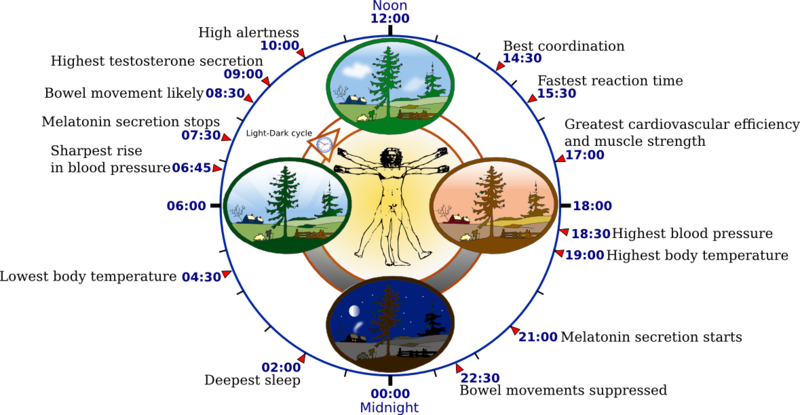
Courtesy of Wikipedia
I have been kind of sick all weekend, so last night, I took the recommended dose of NyQuil and passed out for 11 hours.
Needless to say, I felt great this morning, but it got me thinking, "why does a good night's sleep make me feel so good?" Here are some interesting facts on sleep:
- Adults who report sleeping 6-7 hours per night live longer than those who sleep more or less.
- Sleep deprivation does adversely effect the immune system, but has not been proven to stunt growth in children.
- In mammals, the amount of sleep needed is generally inversely related to size (rats sleep 14 hours per day, while elephants sleep 3-4).
- Despite popular belief, tryptophan has not been linked to changes in sleep patterns. Turkey does not magically make you tired, but overeating and certain times of the day do.
- Your body experiences a natural dip in alertness at both 2am and 2pm.
- REM sleep is important in brain growth and maturity. Deprivation in REM sleep can lead to behavioral and psychological problems
- Drinking alcohol may make you feel sleepy by causing somnolence, but it reduces the amount of REM sleep that you get.
Courtesy of Wikipedia
August 19, 2010
Congratulations, Mrs. Diaz
Cameron Diaz won the prestigious "Most Infected Celebrity" award this year. McAfee's top 10 list includes such notables as Heidi Klum and Penelope Cruz as well as male heart-throbs Brad Pitt and Tom Cruise (apparently "Knight and Day" was popular with hackers).

With an average age of 36 in the top 10 list, I am assuming that middle-aged people still don't understand that clicking on links like "See CAMERON DIAZ naked!" is a great way to get yourself a nice little Daprosy Worm.

With an average age of 36 in the top 10 list, I am assuming that middle-aged people still don't understand that clicking on links like "See CAMERON DIAZ naked!" is a great way to get yourself a nice little Daprosy Worm.
Some Levity for Good Measure
I've been trying to make my blog a little more entertaining lately, because I know how boring reading is for most people, so here's a break from science with a little social comedy by Maz Jobrani:
August 18, 2010
The End of Humans, the Rise of Bacteria
Very few thinking people are naive enough to believe that humans will remain the dominant species on this earth forever. "Forever" is a long time. I'm sure that if dinosaurs possessed the level of cognitive thinking that humans do, they would have thought they were going to live forever too. Of course, dinosaurs are a whole grouping of various species that are somewhere between birds and reptiles, but they roamed the earth for 165 million years. Mammals have only been a dominant species for the better part of the last 60 million years, so should we be looking for the downfall of mammals anytime soon?
Provided a drastic change in climate or other unforeseen disaster occurs, probably not, but the human species? That's a whole different question. I don't buy into scare tactics by the media or even scientists. It's too hard to tell who's got an agenda these days, but I do believe that in some ways, our modern medicine is both saving and destroying our species.
Curious Cat Science and Engineering Blog is one of my favorite weekly reads (despite it's late 90's website design format). Check out his newest article on the end of antibiotics and potentially the end of humans:
http://engineering.curiouscatblog.net/2010/08/15/are-you-ready-for-a-world-without-antibiotics/

Provided a drastic change in climate or other unforeseen disaster occurs, probably not, but the human species? That's a whole different question. I don't buy into scare tactics by the media or even scientists. It's too hard to tell who's got an agenda these days, but I do believe that in some ways, our modern medicine is both saving and destroying our species.
Curious Cat Science and Engineering Blog is one of my favorite weekly reads (despite it's late 90's website design format). Check out his newest article on the end of antibiotics and potentially the end of humans:
http://engineering.curiouscatblog.net/2010/08/15/are-you-ready-for-a-world-without-antibiotics/

August 16, 2010
Sustainability
It's a word that has gotten a lot of attention in the past 10 or so years. We have finally discovered that we have the power to essentially use-up the world's resources. Of course none of us want that, but Jason Clay offers a "solution" (PS - I love TED) :
I see some problems with this philosophy though. I appreciate the progress he is making, and I agree that we need to address this issue of diminishing resources and growing population, but I don't think the solution is as simple and neat as Dr. Clay believes. Here's the way I see it:
Private Business is a competitive environment. Without short-term profits, a company will struggle and die at the hands of companies who will sacrifice long-term access to resources for short-term competitive gains. For example, Company A has an idealistic CEO who leads his company in the direction of sustainability. He says, "We will no longer support any environmentally or ecologically detrimental suppliers, and we will conduct business in a manner that will conserve as many natural resources as possible." Sounds great...
Meanwhile, Company B - a similar company - has a more traditional capitalist serving as CEO who's goal is to drive out competition, and maximize profits for expansion and reinvestment. He knows about Company A's new goal of sustainability, so he decides to fight fire with fire.
Company A may be able to make a great marketing campaign to promote their new commitment to sustainability, but being that they are bound to have larger materials costs since they are no longer buying from "traditional" suppliers, their profits will likely falter. Meanwhile, Company B launches a marketing campaign promoting their lower prices, and then puts a little side bar about their new "green" packaging (mostly just marketing fluff, but the consumer doesn't know any better). Company B has lower costs, and sells their product for a significantly lower price, plus they too have some interest in saving the environment. What happens next? Since this is hypothetical, there's not a right answer, but I'm putting my stock in Company B.
My point is that companies will not buy into this 100% sustainability if they will lose money from it. That's just Econ 101. It doesn't matter if the resource you are taking from the land will be gone in 75 years; if you are a well-run business, you will have already foreseen this, and redirected your investment into another channel by then. We have made some gains in environmental awareness in the past decade, but those have been far outweighed by increasing population, and the boom of industry in the developing world. Maybe I'm just a skeptic, but I have very little faith in Dr. Clay's solution.
I see some problems with this philosophy though. I appreciate the progress he is making, and I agree that we need to address this issue of diminishing resources and growing population, but I don't think the solution is as simple and neat as Dr. Clay believes. Here's the way I see it:
Private Business is a competitive environment. Without short-term profits, a company will struggle and die at the hands of companies who will sacrifice long-term access to resources for short-term competitive gains. For example, Company A has an idealistic CEO who leads his company in the direction of sustainability. He says, "We will no longer support any environmentally or ecologically detrimental suppliers, and we will conduct business in a manner that will conserve as many natural resources as possible." Sounds great...
Meanwhile, Company B - a similar company - has a more traditional capitalist serving as CEO who's goal is to drive out competition, and maximize profits for expansion and reinvestment. He knows about Company A's new goal of sustainability, so he decides to fight fire with fire.
Company A may be able to make a great marketing campaign to promote their new commitment to sustainability, but being that they are bound to have larger materials costs since they are no longer buying from "traditional" suppliers, their profits will likely falter. Meanwhile, Company B launches a marketing campaign promoting their lower prices, and then puts a little side bar about their new "green" packaging (mostly just marketing fluff, but the consumer doesn't know any better). Company B has lower costs, and sells their product for a significantly lower price, plus they too have some interest in saving the environment. What happens next? Since this is hypothetical, there's not a right answer, but I'm putting my stock in Company B.
My point is that companies will not buy into this 100% sustainability if they will lose money from it. That's just Econ 101. It doesn't matter if the resource you are taking from the land will be gone in 75 years; if you are a well-run business, you will have already foreseen this, and redirected your investment into another channel by then. We have made some gains in environmental awareness in the past decade, but those have been far outweighed by increasing population, and the boom of industry in the developing world. Maybe I'm just a skeptic, but I have very little faith in Dr. Clay's solution.
July 26, 2010
Tonight There's Gonna be a Jailbreak
Digital copyright laws are a tough issue to keep up with and enforce for law-makers. The rapid change in technological capabilities and software/hardware available to the public and media manufacturers changes as fast as laws can be drafted and put into effect, but the Digital Millennium Copyright Act tries to keep things current by allowing the Library of Congress to review DRM exceptions every three years. This year, some (semi)major changes came into effect. Rather than write all this out, I'll give you the link:
Listing of exemptions made this year
Gizmodo's take on it
So the big takeaways for me:
Now I can legally jailbreak my iPad, allowing it to do all those little things that I wish it could do before but Mother-Apple didn't see fit to allow me to do. I may try it out tonight if I have time.
Also, I can take clips from movies and use them for my own "non-commercial" videos...okay, that doesn't really concern me since I don't really make videos, but I can see that news as exciting. Now I can watch Pokemon/Family guy mash-up videos anytime I want!
Listing of exemptions made this year
Gizmodo's take on it
So the big takeaways for me:
Now I can legally jailbreak my iPad, allowing it to do all those little things that I wish it could do before but Mother-Apple didn't see fit to allow me to do. I may try it out tonight if I have time.
Also, I can take clips from movies and use them for my own "non-commercial" videos...okay, that doesn't really concern me since I don't really make videos, but I can see that news as exciting. Now I can watch Pokemon/Family guy mash-up videos anytime I want!
July 25, 2010
Thumbs up to MIT
I discovered it last year sometime, and was then reminded of it when browsing the internet today. If you have any interest in advancing your knowledge in a subject that isn't in your major, or one that is not offered by your college, take a look. This would also be a great resource for students starting out their college career or who want more insight into prospective majors. Of course, you don't get credit for doing the online classes, it's a great resource, and I give MIT a big thumbs up for this one.
July 21, 2010
How to Grow a New Body
If you haven't noticed, I'm kind of a big fan of medical technology (I can't wait until they implant a chip in my brain that makes me instantly know Chinese). Anyway, humans in most developed countries tend to die from cancer or heart disease. We've pretty much eliminated most other significant killers out there, but your body was not made to last forever - even if you never get sick - so eventually, organs wear out and break down...UNTIL NOW!
That's right, Harvard Bioscience has successfully grown rat lungs in a bioreactor (that means, the lungs grew in an artificial environment), and then transplanted said lungs into several rats. Okay, the technology may not be ready for human testing - the rats died within 6 hours - but I think this shows feasability in the idea, and I can imagine that research will continue. Pretty cool stuff if you asked me, but I don't want science to stop there...
If I start getting old and "wearing out", I want them to go ahead and transport what memories and cognitive ability I have left into a completely new body. Harvest me all new organs, slap some skin on me, do a little reconstructive surgery to make sure I look right, and send me out for round two. My mom used to read me "You're Only Old Once" by Dr. Suess as a kid...not anymore, Doctor Geisel!

That's right, Harvard Bioscience has successfully grown rat lungs in a bioreactor (that means, the lungs grew in an artificial environment), and then transplanted said lungs into several rats. Okay, the technology may not be ready for human testing - the rats died within 6 hours - but I think this shows feasability in the idea, and I can imagine that research will continue. Pretty cool stuff if you asked me, but I don't want science to stop there...
If I start getting old and "wearing out", I want them to go ahead and transport what memories and cognitive ability I have left into a completely new body. Harvest me all new organs, slap some skin on me, do a little reconstructive surgery to make sure I look right, and send me out for round two. My mom used to read me "You're Only Old Once" by Dr. Suess as a kid...not anymore, Doctor Geisel!
July 19, 2010
The job search
I've had a number of friends graduate this past spring, and have been surprised at the large number of them who have not succeeded in finding a start to their career. Many have been able to get some sort of job, but even among my fellow engineering students, the offers are not as plentiful as they once were, and many I know have settled with a job that may be far from their desired field. This has just solidified my decision to take my time completing my undergraduate degree (especially because my scholarships will go for up to 6 years), but I'd like to take a little time to offer up my tips on job-hunting for anyone out there who's interested:
1. Be Proactive. I don't just mean go to career services and ask them for a list of companies who will be coming to the job fair. Do research. This is especially true if you have a very specialized major, or have very specific goals in the long-term, but even if you don't, you need to know what you're looking for out there in the real world. Job fairs are a great resource, and should never be skipped in hopes of finding work else-where (that face-to-face meeting usually works in your favor), but don't forget to do a little digging, and see what other companies may be out there.
2. Network! Don't pass up the chance to talk to any company representative, at any time, ever. If you get the opportunity to meet a rep at a job fair, class, or special event, take advantage of it. Like I said above, face-time with recruiters is the ideal way to make a good impression. Be confident, look them in the eye, shake their hand, remember their name, and ask them questions about their company, and who they are looking to hire. Finally, I won't leave the networking section without giving the suggestion to use the internet. This is something that is not nearly as personal as a face-to-face meeting, but it can help you in ways that you probably don't realize. Say for example, you follow GE's "ecomagination" on twitter.com. If you got the chance to meet a company rep for GE, you could bring up the latest news that was shared on twitter, and probably show that you really do follow the company, and keep up with its latest innovations.
3. Just keep trying. This may be the hardest thing for some people, as being rejected time and time again can really start to wear on a person's confidence, but you're not alone in your struggle for that perfect job. If you follow Ask A Manager (one of my personal favorites), you will see many stories from working professionals who have sent dozens or hundreds of resume's out, and received no offers back. Finally, along these lines, I don't recommend "taking time off" for a year after college. Maybe spending a couple months traveling isn't a bad thing, but if I were an employer, I'd be much more impressed by an applicant who spent his time volunteering for a year while looking for a job than just living at home, mooching off his parents as long as he could.
For what it's worth, that is my advice. Feel free to comment, or add your own suggestions, and best of luck to you all!
1. Be Proactive. I don't just mean go to career services and ask them for a list of companies who will be coming to the job fair. Do research. This is especially true if you have a very specialized major, or have very specific goals in the long-term, but even if you don't, you need to know what you're looking for out there in the real world. Job fairs are a great resource, and should never be skipped in hopes of finding work else-where (that face-to-face meeting usually works in your favor), but don't forget to do a little digging, and see what other companies may be out there.
2. Network! Don't pass up the chance to talk to any company representative, at any time, ever. If you get the opportunity to meet a rep at a job fair, class, or special event, take advantage of it. Like I said above, face-time with recruiters is the ideal way to make a good impression. Be confident, look them in the eye, shake their hand, remember their name, and ask them questions about their company, and who they are looking to hire. Finally, I won't leave the networking section without giving the suggestion to use the internet. This is something that is not nearly as personal as a face-to-face meeting, but it can help you in ways that you probably don't realize. Say for example, you follow GE's "ecomagination" on twitter.com. If you got the chance to meet a company rep for GE, you could bring up the latest news that was shared on twitter, and probably show that you really do follow the company, and keep up with its latest innovations.
3. Just keep trying. This may be the hardest thing for some people, as being rejected time and time again can really start to wear on a person's confidence, but you're not alone in your struggle for that perfect job. If you follow Ask A Manager (one of my personal favorites), you will see many stories from working professionals who have sent dozens or hundreds of resume's out, and received no offers back. Finally, along these lines, I don't recommend "taking time off" for a year after college. Maybe spending a couple months traveling isn't a bad thing, but if I were an employer, I'd be much more impressed by an applicant who spent his time volunteering for a year while looking for a job than just living at home, mooching off his parents as long as he could.
For what it's worth, that is my advice. Feel free to comment, or add your own suggestions, and best of luck to you all!
June 29, 2010
What happens when Google competes with Facebook?
Google Me - a rumored social networking project by Google - looks like it is actually in the works:
http://techcrunch.com/2010/06/29/google-me-facebook/
Clearly Google sees the benefit of social networking integrated with its already wide variety of internet-based holdings, and I think I do too. Although it's obviously going to take a while before it reaches the widespread popularity and universiality that Facebook has already achieved, Google Me has the already expansive Google network at its back. Users of Gmail and Blogger will likely become the first participants, and with YouTube now owned by Google, there is a huge potential market of users and viewers. Personally, I can't wait.
http://techcrunch.com/2010/06/29/google-me-facebook/
Clearly Google sees the benefit of social networking integrated with its already wide variety of internet-based holdings, and I think I do too. Although it's obviously going to take a while before it reaches the widespread popularity and universiality that Facebook has already achieved, Google Me has the already expansive Google network at its back. Users of Gmail and Blogger will likely become the first participants, and with YouTube now owned by Google, there is a huge potential market of users and viewers. Personally, I can't wait.
June 23, 2010
KarlLHughes.com gets a make-over
Well, I'm still having some trouble viewing my website with my version of Internet Explorer (it's the darn transparent tables), but it appears to be working great in Firefox. I think the load time is a little high (probably need to lower my image quality on some of the pages), and I think I need a new Javascript slideshow for the main page to speed the load time.
It's still got some work, but I think it looks a lot better than that crappy template I had up before. Check it out, and please send me your feedback so I can work on improving it, thanks!
www.KarlLHughes.com
It's still got some work, but I think it looks a lot better than that crappy template I had up before. Check it out, and please send me your feedback so I can work on improving it, thanks!
www.KarlLHughes.com
June 22, 2010
Navigating the "Smart Grid" for Dummies
If you know how the power grid works in most countries and areas inside of our country, you know that we rely on a very archaic system that has remained largely unchanged from the power grid envisioned by Nikola Tesla over 100 years ago, but the emergence of faster data transfer (ie: the internet) has led to some exciting new possibilities in saving energy intelligently. So what does this new "smart" system do?
"A smart grid delivers electricity from suppliers to consumers using two-way digital technology to control appliances at consumers' homes to save energy, reduce cost and increase reliability and transparency. It overlays the electricity distribution grid with an information and net metering system.
Such a modernized electricity network is being promoted by many governments as a way of addressing energy independence, global warming and emergency resilience issues. Smart meters may be part of a smart grid, but alone do not constitute a smart grid.
A smart grid includes an intelligent monitoring system that keeps track of all electricity flowing in the system. It also incorporates the use of superconductive transmission lines for less power loss, as well as the capability of integrating renewable electricity such as solar and wind. When power is least expensive the user can allow the smart grid to turn on selected home appliances such as washing machines or factory processes that can run at arbitrary hours. At peak times it could turn off selected appliances to reduce demand." - Wikipedia
If you know anything about "green" or "alternative" engergy, you probably know that there's just not enough of it to supply our current (and growing) energy needs. Sure, there are a few places in the world where wind or solar or geothermal energy can feed the area's energy needs, but by and large, this is not true, especially as China's energy use per capita nearly doubled between 1990 and 2005, and although I have yet to find data to back this up, I am guessing it is continuing to rise, and likely at a faster rate.
This being said, I don't think that we will cut our dependence on fossil fuels anytime soon, but the use of efficient energy use and delivery systems can be part of the road that gets us closer to that goal.
"A smart grid delivers electricity from suppliers to consumers using two-way digital technology to control appliances at consumers' homes to save energy, reduce cost and increase reliability and transparency. It overlays the electricity distribution grid with an information and net metering system.
Such a modernized electricity network is being promoted by many governments as a way of addressing energy independence, global warming and emergency resilience issues. Smart meters may be part of a smart grid, but alone do not constitute a smart grid.
A smart grid includes an intelligent monitoring system that keeps track of all electricity flowing in the system. It also incorporates the use of superconductive transmission lines for less power loss, as well as the capability of integrating renewable electricity such as solar and wind. When power is least expensive the user can allow the smart grid to turn on selected home appliances such as washing machines or factory processes that can run at arbitrary hours. At peak times it could turn off selected appliances to reduce demand." - Wikipedia
If you know anything about "green" or "alternative" engergy, you probably know that there's just not enough of it to supply our current (and growing) energy needs. Sure, there are a few places in the world where wind or solar or geothermal energy can feed the area's energy needs, but by and large, this is not true, especially as China's energy use per capita nearly doubled between 1990 and 2005, and although I have yet to find data to back this up, I am guessing it is continuing to rise, and likely at a faster rate.
This being said, I don't think that we will cut our dependence on fossil fuels anytime soon, but the use of efficient energy use and delivery systems can be part of the road that gets us closer to that goal.
June 18, 2010
Cyberspace Declared a "National Asset"
Ok, so it hasn't passed yet, but Ol' Joe Lieberman has brought a bill up in the Senate that gives the government the ability to effectively turn off or alter the internet in the case of a national emergency.
http://gizmodo.com/5567094/new-bill-would-give-the-president-an-internet-kill-switch
No part of that sounds good to me. I can't really think of a situation where the internet would need to be turned off by my government. I'm okay with government regulations involving public safety, but this is too far for my tastes.
Another interesting page I found recently on google shows how many site removal requests have been submitted by each country. The US ranks 4th (China is not included though).
http://www.google.com/governmentrequests/
Maybe these were just requests to remove terrible things (ie: child pornography, "snuff" films, etc.), but who draws the line? I guess that's always the trouble with increasing regulation though; at some point, "regulation" becomes "paternalism" which eventually becomes "totalitarianism". Give Orwell's 1984 a read sometime before the next election, and think about it.
And before you blame it all on the Democrats, read up on the USA PATRIOT Act sometime.
http://gizmodo.com/5567094/new-bill-would-give-the-president-an-internet-kill-switch
No part of that sounds good to me. I can't really think of a situation where the internet would need to be turned off by my government. I'm okay with government regulations involving public safety, but this is too far for my tastes.
Another interesting page I found recently on google shows how many site removal requests have been submitted by each country. The US ranks 4th (China is not included though).
http://www.google.com/governmentrequests/
Maybe these were just requests to remove terrible things (ie: child pornography, "snuff" films, etc.), but who draws the line? I guess that's always the trouble with increasing regulation though; at some point, "regulation" becomes "paternalism" which eventually becomes "totalitarianism". Give Orwell's 1984 a read sometime before the next election, and think about it.
And before you blame it all on the Democrats, read up on the USA PATRIOT Act sometime.
June 16, 2010
Electric Cars, anyone?
Check out this article from Gizmodo about early attempts by Thomas Edison and Henry Ford to produce and market electric cars.
I find it interesting that the problem they had nearly 100 years ago is the same problem we are seeing today: batteries. I know the debate over switching to electric cars has pros and cons, and being that I don't know much about how electric car batteries work, this whole thing is arguable, but it's interesting that we still haven't been able to get the power to weight/size ratio down. Hopefully soon, because I like the idea of driving a smooth, quiet, efficient car, even if it was charged off a fossil fuel source that is actually less efficient than an internal combustion engine.
I find it interesting that the problem they had nearly 100 years ago is the same problem we are seeing today: batteries. I know the debate over switching to electric cars has pros and cons, and being that I don't know much about how electric car batteries work, this whole thing is arguable, but it's interesting that we still haven't been able to get the power to weight/size ratio down. Hopefully soon, because I like the idea of driving a smooth, quiet, efficient car, even if it was charged off a fossil fuel source that is actually less efficient than an internal combustion engine.
June 14, 2010
Money for nothin' and energy for free?
First, I will apologize for the hiatus I've taken from posting. I try to write something at least once a week, but I've been heavily involved in re-vamping my website in addition to my two jobs and numerical analysis class, so I'll play catch up tonight.
In the wake of the BP spill that is dominating at least 90% of CNN's programming every day, I feel like this disaster is worth another post from a slightly different approach. I'd like to play the blame game along with all the other pundits, politicians, and professionals out there, but I'm not going to tell you what you want to hear...
YOU are to blame. Not just you though, I am to blame, and so is every other person living in the modernized world we are a part of. Both directly and indirectly, and I doubt most people realize just how much they use petroleum-based products. Besides the obvious use of gas and oil in your car, most commercial plastics are actually made from petroleum, and if you haven't looked around lately, you probably use plastics more than any other single material in your home or place of work. So, we can sit here pointing fingers at the BP executives, but they were simply obeying the laws of the capitalist system that America provides them (maximize profit, even if it's risky), and we each have the right to change our government via elections, revolutions, etc., so once again, the blame circulates back to us.
I say all that, and it sounds like I'm spouting idealist-socialist-hippy-bull...poop, but that is not actually my point. My point is that nothing is free, and when you as a voter, consumer, and citizen choose to remain ignorant about an industry that you freely choose to support, you cannot later place blame on that industry just because you naively trusted them with not only your life, but the lives of your fellow man and your environment.
So rather than sit around debating which executive or politician you can point your fingers at, and lamenting the destruction of the environment over a cup of Starbuck's coffee, get up and find a way to improve the technology and energy sources that you and I rely on daily. The US Government is likely to crack down, and spend millions (or billions) re-writing and enforcing new regulations on the oil industry, when the long-term answer lies not in enforcement, but improvement. The latest economic crunch has led schools (including UT) to make cuts in all areas, including science, engineering, and math, but in the light of disasters like this, I think it's time we re-thought our priorities in regards to education. Without getting into that argument, I think that we as citizens here need to take the time to try to understand and educate ourselves on these modern conveniences that we take so much for granted, and realize that nothing comes for free.
In the wake of the BP spill that is dominating at least 90% of CNN's programming every day, I feel like this disaster is worth another post from a slightly different approach. I'd like to play the blame game along with all the other pundits, politicians, and professionals out there, but I'm not going to tell you what you want to hear...
YOU are to blame. Not just you though, I am to blame, and so is every other person living in the modernized world we are a part of. Both directly and indirectly, and I doubt most people realize just how much they use petroleum-based products. Besides the obvious use of gas and oil in your car, most commercial plastics are actually made from petroleum, and if you haven't looked around lately, you probably use plastics more than any other single material in your home or place of work. So, we can sit here pointing fingers at the BP executives, but they were simply obeying the laws of the capitalist system that America provides them (maximize profit, even if it's risky), and we each have the right to change our government via elections, revolutions, etc., so once again, the blame circulates back to us.
I say all that, and it sounds like I'm spouting idealist-socialist-hippy-bull...poop, but that is not actually my point. My point is that nothing is free, and when you as a voter, consumer, and citizen choose to remain ignorant about an industry that you freely choose to support, you cannot later place blame on that industry just because you naively trusted them with not only your life, but the lives of your fellow man and your environment.
So rather than sit around debating which executive or politician you can point your fingers at, and lamenting the destruction of the environment over a cup of Starbuck's coffee, get up and find a way to improve the technology and energy sources that you and I rely on daily. The US Government is likely to crack down, and spend millions (or billions) re-writing and enforcing new regulations on the oil industry, when the long-term answer lies not in enforcement, but improvement. The latest economic crunch has led schools (including UT) to make cuts in all areas, including science, engineering, and math, but in the light of disasters like this, I think it's time we re-thought our priorities in regards to education. Without getting into that argument, I think that we as citizens here need to take the time to try to understand and educate ourselves on these modern conveniences that we take so much for granted, and realize that nothing comes for free.
June 4, 2010
Yes, I would like to live forever, thank you very much!
For all those who say they don't want to have a computer implanted inside of them, I bet that will change when it can save your life:
Do You Want to Live Forever?
Do You Want to Live Forever?
The end of unlimited wireless signals the rise of WiFi
AT&T and Verizon, two of the US's largest cell-phone carriers, and (I'm going to assume) the largest distributors of wireless internet in the country have now both announced that they will no longer make "unlimited use" wireless plans available to their customers. My guess is that the big two were getting too much demand for data from their networks, and had to find a way to manage it. I'm going to go ahead and announce my predictions for the future of wireless/portable internet:
1. Cell phone bills skyrocket for some, stay the same for others. With the rise of 3G tablets and super-capable smart phones, customers subscribing to the new "Pay-as-you-go" internet plans will undoubtedly pay more than the $35 per month that they paid for the now-defunct unlimited plans. AT&T's new data rate is set-up so that you pay $20 per month for 20 MB of data (about 9 minutes of YouTube video), but in an age that is moving rapidly in the direction of mobile computing, this will prove to be far too expensive for even a casual phone internet user, but for $60 per month you can get a whole 5GB of data. Now 5GB is probably enough for most people in a month, but who wants to fork over $60 for it? Not me, and probably not you, which is why I predict...
2. The rise of WiFi. Its likely that this won't all be free either, but the competition from an increased number of WiFi hotspots could seriously damage the cell companies' ability to charge such exorbitant prices for mobile internet. We'll also have to see who starts to dominate the WiFi network though, because a lot of them are managed by AT&T or Verizon, so I could see them raising the price on WiFi hotspots to keep up with the increase in mobile charges.
As kind of a side note, I think we're reaching a sort of bottleneck with internet connection and speeds. Computing is trying to move mobile, and put its storage off in a remote location for access from any computer in the world, but the connection speeds don't yet make it practical. Maybe Google's fiber optic idea will catch on...I can dream at least.
1. Cell phone bills skyrocket for some, stay the same for others. With the rise of 3G tablets and super-capable smart phones, customers subscribing to the new "Pay-as-you-go" internet plans will undoubtedly pay more than the $35 per month that they paid for the now-defunct unlimited plans. AT&T's new data rate is set-up so that you pay $20 per month for 20 MB of data (about 9 minutes of YouTube video), but in an age that is moving rapidly in the direction of mobile computing, this will prove to be far too expensive for even a casual phone internet user, but for $60 per month you can get a whole 5GB of data. Now 5GB is probably enough for most people in a month, but who wants to fork over $60 for it? Not me, and probably not you, which is why I predict...
2. The rise of WiFi. Its likely that this won't all be free either, but the competition from an increased number of WiFi hotspots could seriously damage the cell companies' ability to charge such exorbitant prices for mobile internet. We'll also have to see who starts to dominate the WiFi network though, because a lot of them are managed by AT&T or Verizon, so I could see them raising the price on WiFi hotspots to keep up with the increase in mobile charges.
As kind of a side note, I think we're reaching a sort of bottleneck with internet connection and speeds. Computing is trying to move mobile, and put its storage off in a remote location for access from any computer in the world, but the connection speeds don't yet make it practical. Maybe Google's fiber optic idea will catch on...I can dream at least.
June 2, 2010
This could change the iPad
It looks like someone has come up with a solution to the absence of Flash on the iPad and iPhone:
http://gizmodo.com/5552545/smokescreen-converts-flash-to-javascript-on-the-fly
As the article says, it's a little "hefty" at the moment, but the open-source nature of the software leads me to think that this could be up and running on Flash-free devices soon...assuming Apple will let it.
http://gizmodo.com/5552545/smokescreen-converts-flash-to-javascript-on-the-fly
As the article says, it's a little "hefty" at the moment, but the open-source nature of the software leads me to think that this could be up and running on Flash-free devices soon...assuming Apple will let it.
Props to UT
Some interesting facts about UT Knoxville from their website:
As the state's flagship, research-intensive university, UT is the state's leader in promoting education, research and public service and continues to strengthen its impact on the citizens of Tennessee.
U.S. News and World Report ranked UT Knoxville as No. 52 among all public universities and No. 106 among all national universities for 2010. The national universities group includes 262 American universities that offer the comprehensive bachelor's, master's and doctoral degrees.
Academic Reputation
U.S. News and World Report ranks UT graduate programs among the best in the nation for 2010. The supply chain management and logistics program is ranked ninth among all national universities. The College of Law's clinical training program is 15th nationally, and the College of Engineering's graduate program in nuclear engineering is ranked 12th nationally.
The magazine ranked UT's College of Business Administration undergraduate business program 28th in the nation among public institutions and 48th among all national universities. The magazine also gives high rankings to the college's undergraduate program in supply chain management/logistics, which ranked seventh nationally and fifth among public universities. The College of Engineering undergraduate program ranked 32nd among public institutions and 64th nationwide.
In 2008, U.S. News and World Report ranked the School of Art's MFA in printmaking program fourth nationally, and the College of Social Work's graduate program ranked 15th among public universities and 26th overall.
Forbes Magazine lists UT in its 2010 edition of "America's Best Colleges" based on quality of education and how much graduates achieve after receiving their degree. Forbes also cited UT Knoxville's College of Business Administration as 42nd out of 75 for its MBA program, on a list that contains both public and private institutions.
The Princeton Review lists UT in its 2010 edition of "The Best 371 Colleges," making the grade with just 15 percent of America's 2,500 four-year colleges chosen. UT also was cited for the second year in a row for its environmental friendliness, scoring an 85 on the publication's "green rating." The magazine also named the full-time MBA program one of the nation's "Best 301 Business Schools," and the College of Law one of the "Best 172 Law Schools" in its 2010 editions of those publications.
The Princeton Review also named UT a "Best Southeastern College" for its high standards and outstanding reputation among higher education institutions in the Southeast. The magazine in 2009 also ranked UT Knoxville among the 100 "Best Value Colleges" based on undergraduate academics, affordability and financial aid.
National Jurist Magazine ranked the College of Law as the nation’s 14th Best Value Law School.
Kiplinger's Personal Finance magazine ranked UT as one of the top 100 universities in the nation in 2009 for "best value," a measure of the quality of academic programs compared to costs and financial aid.
Diverse: Issues in Higher Education this year ranked UT as a "Top 100 Doctorate Degree Producer" institution for African Americans.
The Sustainable Endowments Institute gave UT high remarks in its 2009 College Sustainability Report Card for making strides in green initiatives, rating it the greenest university in the state, and among the top four among Southeastern Conference member institutions. UT Knoxville was also the first university in the state to institute a student fee for the purchase of green power.
Make Orange Green, the campus environmental effort, has been honored across the state and nation as one of the top campus environmental programs. UT Knoxville campus environmental programs have been recognized in BusinessWeek and Newsweek magazines.
UT Knoxville also was named a "Military Friendly School" by G.I. Jobs magazine. This ranking places the institution in the top 15 percent of all colleges, universities and trade schools nationwide.
Forty percent of the incoming freshmen had GPAs of 4.0 or higher. There are 40 National Merit scholarship winners in the incoming freshman class.
The HOPE Scholarship began in 2004, and UT Knoxville officials say the scholarship has impacted the flagship university more than any institution in the state by increasing applicants, bolstering incoming students' academic preparedness and allowing the university to increase access by creating need-based scholarship programs. About 99 percent of in-state freshmen qualified for the HOPE Scholarship.
Fifteen of the nation's top students recently accepted the invitation to attend UT Knoxville as the inaugural class of Haslam Scholars—a premier program that offers special opportunities for undergraduate research projects and study abroad.
Graduate students from UT Knoxville recently were awarded prestigious Fulbright and DAAD (German Academic Exchange Service) external scholarship grants to study and research in Europe. A new Office of External Scholarships focuses on helping students compete for these and other top awards like the Rhodes, Marshall and Truman scholarships.
The University of Tennessee is classified as a research university with very high research activity (RU/VH) by the Carnegie Commission. The Center for Measuring University Performance, formerly Lombardi, an organization that ranks the top 200 research universities, ranked UT 31st nationally, up from 47th.
UT is a key economic driver in the state and its partnership with Battelle Memorial Institute to manage Oak Ridge National Laboratory (ORNL) supplies the fuel for continued growth and diversification. This partnership formalizes the university's longstanding collaborative relationship with one of the nation's premier research facilities and the U.S. Department of Energy's largest national laboratory.
UT Knoxville's Center for Business and Economic Impact recently estimated the economic impact of the campus on the state of Tennessee at more than $800 million, which accounts not only for direct expenditures by the university, but also the multiplied impact of things like spending by employees, jobs created by research funding and more.
Funding from the National Science Foundation (NSF) to UT Knoxville is at an all-time high. New awards from NSF for 2009 totaled more than $24 million, and four major NSF awards since 2007 have vaulted UT Knoxville into the national spotlight with funding for world-leading science and research endeavors.
UT Knoxville is now home to the one of the world's most powerful academic computers. Called Kraken, the computer is funded by a $65 million NSF award—the largest in the history of the UT system. The computer will allow researchers from UT Knoxville and around the world to find answers to humankind's most pressing questions from climate change to drug design. Kraken is the world's sixth fastest computer.
Joining Kraken will be Nautilus, a $10 million supercomputer whose purpose will be to take the staggering amount of data created by computers like Kraken and interpret it in ways that are meaningful. Not only is UT Knoxville leading the way in big computing, but it is leading they way to ensure that computing research has a broader impact on the world.
NSF also recently awarded UT Knoxville $16 million to begin the National Institute for Mathematical and Biological Synthesis (NIMBioS), a first-of-its-kind center dedicated to finding creative solutions to major ecological and biological problems from animal disease to wildfire control. NIMBioS brings hundreds of scientists to UT Knoxville and puts millions of dollars into the local economy.
The NSF also has awarded $3 million Integrative Graduate Education Research and Training, or IGERT, awards to two UT Knoxville research groups studying sustainable technology and scalable computing. The centers will bring the nation's top graduate students to UT Knoxville.
UT's managing partnership with ORNL is enhancing the state's role as a growing hub for research in topics that will affect the lives of all people in the coming years, including alternative energy, national security and the creation of new materials. ORNL's crown jewel is the Spallation Neutron Source, which allows researchers from the United States and all over the world to use neutrons to understand the most fundamental structures and processes of matter, transforming it for uses that were unimaginable even a few short years ago.
UT and ORNL have created joint institutes in areas such as biological sciences, computational sciences, heavy ion research, nanophase materials sciences and neutron sciences. These joint institutes take advantage of the instructional and research strengths offered by the university and the national lab, and have already served as magnets for top researchers and major funding for centers housing resources like Kraken.
UT Knoxville is now home to five UT-ORNL Governor's Chairs. These faculty members, who hold a joint appointment with ORNL, are among the nation's best and brightest, and were recruited to UT Knoxville as part of the ambitious program that is supported by funding from the state of Tennessee. By providing resources for these faculty to conduct cutting-edge research in relevant topics, UT is establishing itself as a powerful hub for top scientists.
UT Knoxville's Center for Business and Economic Research measures the dollars the institution generates. Conservatively, UT Knoxville's impact approaches one billion dollars -- that's 24,000 jobs and $80 million in tax revenue.
UT Knoxville contributes to every aspect of life, from theater and music, science and technology, to law and athletics. The institution is moving forward in its mission to be the preeminent public research and teaching university linking the people of Tennessee to the nation and the world."
Source:
http://utk.edu/features/rankings.shtml
UT A Top National Public University
"From ever-increasing research dollars to affordability and value, the University of Tennessee, Knoxville, is recognized by many for its high-quality programs and initiatives that prepare students to thrive in a global economy.As the state's flagship, research-intensive university, UT is the state's leader in promoting education, research and public service and continues to strengthen its impact on the citizens of Tennessee.
U.S. News and World Report ranked UT Knoxville as No. 52 among all public universities and No. 106 among all national universities for 2010. The national universities group includes 262 American universities that offer the comprehensive bachelor's, master's and doctoral degrees.
Academic Reputation
U.S. News and World Report ranks UT graduate programs among the best in the nation for 2010. The supply chain management and logistics program is ranked ninth among all national universities. The College of Law's clinical training program is 15th nationally, and the College of Engineering's graduate program in nuclear engineering is ranked 12th nationally.
The magazine ranked UT's College of Business Administration undergraduate business program 28th in the nation among public institutions and 48th among all national universities. The magazine also gives high rankings to the college's undergraduate program in supply chain management/logistics, which ranked seventh nationally and fifth among public universities. The College of Engineering undergraduate program ranked 32nd among public institutions and 64th nationwide.
In 2008, U.S. News and World Report ranked the School of Art's MFA in printmaking program fourth nationally, and the College of Social Work's graduate program ranked 15th among public universities and 26th overall.
Forbes Magazine lists UT in its 2010 edition of "America's Best Colleges" based on quality of education and how much graduates achieve after receiving their degree. Forbes also cited UT Knoxville's College of Business Administration as 42nd out of 75 for its MBA program, on a list that contains both public and private institutions.
The Princeton Review lists UT in its 2010 edition of "The Best 371 Colleges," making the grade with just 15 percent of America's 2,500 four-year colleges chosen. UT also was cited for the second year in a row for its environmental friendliness, scoring an 85 on the publication's "green rating." The magazine also named the full-time MBA program one of the nation's "Best 301 Business Schools," and the College of Law one of the "Best 172 Law Schools" in its 2010 editions of those publications.
The Princeton Review also named UT a "Best Southeastern College" for its high standards and outstanding reputation among higher education institutions in the Southeast. The magazine in 2009 also ranked UT Knoxville among the 100 "Best Value Colleges" based on undergraduate academics, affordability and financial aid.
National Jurist Magazine ranked the College of Law as the nation’s 14th Best Value Law School.
Kiplinger's Personal Finance magazine ranked UT as one of the top 100 universities in the nation in 2009 for "best value," a measure of the quality of academic programs compared to costs and financial aid.
Diverse: Issues in Higher Education this year ranked UT as a "Top 100 Doctorate Degree Producer" institution for African Americans.
The Sustainable Endowments Institute gave UT high remarks in its 2009 College Sustainability Report Card for making strides in green initiatives, rating it the greenest university in the state, and among the top four among Southeastern Conference member institutions. UT Knoxville was also the first university in the state to institute a student fee for the purchase of green power.
Make Orange Green, the campus environmental effort, has been honored across the state and nation as one of the top campus environmental programs. UT Knoxville campus environmental programs have been recognized in BusinessWeek and Newsweek magazines.
UT Knoxville also was named a "Military Friendly School" by G.I. Jobs magazine. This ranking places the institution in the top 15 percent of all colleges, universities and trade schools nationwide.
Top Students
UT's student body is another sign of the university's strides in academic quality. The new 2009 class of 3,723 entering freshmen had an average core GPA of 3.79 and a 26.5 average ACT score—the highest ever for an entering class.Forty percent of the incoming freshmen had GPAs of 4.0 or higher. There are 40 National Merit scholarship winners in the incoming freshman class.
The HOPE Scholarship began in 2004, and UT Knoxville officials say the scholarship has impacted the flagship university more than any institution in the state by increasing applicants, bolstering incoming students' academic preparedness and allowing the university to increase access by creating need-based scholarship programs. About 99 percent of in-state freshmen qualified for the HOPE Scholarship.
Fifteen of the nation's top students recently accepted the invitation to attend UT Knoxville as the inaugural class of Haslam Scholars—a premier program that offers special opportunities for undergraduate research projects and study abroad.
Graduate students from UT Knoxville recently were awarded prestigious Fulbright and DAAD (German Academic Exchange Service) external scholarship grants to study and research in Europe. A new Office of External Scholarships focuses on helping students compete for these and other top awards like the Rhodes, Marshall and Truman scholarships.
Research and Economic Impact
UT Knoxville is committed to the support and advancement of research as a way to enhance the lives of people across Tennessee, the nation and the world. The campus hires faculty with a commitment to world-class research and provides the support necessary for them to bring research dollars to Tennessee. From 2004 to 2009, sponsored research awards at UT Knoxville increased 155 percent, from $113 million to $179 million.The University of Tennessee is classified as a research university with very high research activity (RU/VH) by the Carnegie Commission. The Center for Measuring University Performance, formerly Lombardi, an organization that ranks the top 200 research universities, ranked UT 31st nationally, up from 47th.
UT is a key economic driver in the state and its partnership with Battelle Memorial Institute to manage Oak Ridge National Laboratory (ORNL) supplies the fuel for continued growth and diversification. This partnership formalizes the university's longstanding collaborative relationship with one of the nation's premier research facilities and the U.S. Department of Energy's largest national laboratory.
UT Knoxville's Center for Business and Economic Impact recently estimated the economic impact of the campus on the state of Tennessee at more than $800 million, which accounts not only for direct expenditures by the university, but also the multiplied impact of things like spending by employees, jobs created by research funding and more.
Funding from the National Science Foundation (NSF) to UT Knoxville is at an all-time high. New awards from NSF for 2009 totaled more than $24 million, and four major NSF awards since 2007 have vaulted UT Knoxville into the national spotlight with funding for world-leading science and research endeavors.
UT Knoxville is now home to the one of the world's most powerful academic computers. Called Kraken, the computer is funded by a $65 million NSF award—the largest in the history of the UT system. The computer will allow researchers from UT Knoxville and around the world to find answers to humankind's most pressing questions from climate change to drug design. Kraken is the world's sixth fastest computer.
Joining Kraken will be Nautilus, a $10 million supercomputer whose purpose will be to take the staggering amount of data created by computers like Kraken and interpret it in ways that are meaningful. Not only is UT Knoxville leading the way in big computing, but it is leading they way to ensure that computing research has a broader impact on the world.
NSF also recently awarded UT Knoxville $16 million to begin the National Institute for Mathematical and Biological Synthesis (NIMBioS), a first-of-its-kind center dedicated to finding creative solutions to major ecological and biological problems from animal disease to wildfire control. NIMBioS brings hundreds of scientists to UT Knoxville and puts millions of dollars into the local economy.
The NSF also has awarded $3 million Integrative Graduate Education Research and Training, or IGERT, awards to two UT Knoxville research groups studying sustainable technology and scalable computing. The centers will bring the nation's top graduate students to UT Knoxville.
UT's managing partnership with ORNL is enhancing the state's role as a growing hub for research in topics that will affect the lives of all people in the coming years, including alternative energy, national security and the creation of new materials. ORNL's crown jewel is the Spallation Neutron Source, which allows researchers from the United States and all over the world to use neutrons to understand the most fundamental structures and processes of matter, transforming it for uses that were unimaginable even a few short years ago.
UT and ORNL have created joint institutes in areas such as biological sciences, computational sciences, heavy ion research, nanophase materials sciences and neutron sciences. These joint institutes take advantage of the instructional and research strengths offered by the university and the national lab, and have already served as magnets for top researchers and major funding for centers housing resources like Kraken.
UT Knoxville is now home to five UT-ORNL Governor's Chairs. These faculty members, who hold a joint appointment with ORNL, are among the nation's best and brightest, and were recruited to UT Knoxville as part of the ambitious program that is supported by funding from the state of Tennessee. By providing resources for these faculty to conduct cutting-edge research in relevant topics, UT is establishing itself as a powerful hub for top scientists.
UT Knoxville's Center for Business and Economic Research measures the dollars the institution generates. Conservatively, UT Knoxville's impact approaches one billion dollars -- that's 24,000 jobs and $80 million in tax revenue.
UT Knoxville contributes to every aspect of life, from theater and music, science and technology, to law and athletics. The institution is moving forward in its mission to be the preeminent public research and teaching university linking the people of Tennessee to the nation and the world."
Source:
http://utk.edu/features/rankings.shtml
June 1, 2010
Cyber-Venting
Be careful what you complain about online. As NBA stars have found out, social networking can get you in some hot water if you're famous enough, but who would think a college kid's complaints about a towing company would get him sued?
You can look at the Facebook group that Justin Kurtz started here. Kurtz started a legitimate group complaining about a towing company with poor service, and did not attempt to maliciously defame the company, but rather warn others about them, and allow others to chime in. From the looks of the FB page, not many people in Kalamazoo are a big fan of T&J towing, and from the NY Times article, it appears that the suit is going to get thrown out, but this use of legal bullying by companies should be stopped.
Most suits like this end when the person who posted the complaint online removes his comment or page, and things never go to court. Of course, the defendant may win if he took the time and effort to fight it, but probably doesn't want the trouble involved in a legal battle. This kind of frivolous lawsuit by the company being defamed is basically an intimidation technique. It bothers me that companies think they can just push their own unsatisfied customers around rather than working with them to fix the problem.
I had a similar situation crop up not long ago on Twitter. I posted a complaint about Comcast, and their poor service in our apartment, and received a direct message from a Comcast account on Twitter, offering help. This is the way that these problems should be handled, and it made me feel like Comcast was listening to me rather than fighting me.
You can look at the Facebook group that Justin Kurtz started here. Kurtz started a legitimate group complaining about a towing company with poor service, and did not attempt to maliciously defame the company, but rather warn others about them, and allow others to chime in. From the looks of the FB page, not many people in Kalamazoo are a big fan of T&J towing, and from the NY Times article, it appears that the suit is going to get thrown out, but this use of legal bullying by companies should be stopped.
Most suits like this end when the person who posted the complaint online removes his comment or page, and things never go to court. Of course, the defendant may win if he took the time and effort to fight it, but probably doesn't want the trouble involved in a legal battle. This kind of frivolous lawsuit by the company being defamed is basically an intimidation technique. It bothers me that companies think they can just push their own unsatisfied customers around rather than working with them to fix the problem.
I had a similar situation crop up not long ago on Twitter. I posted a complaint about Comcast, and their poor service in our apartment, and received a direct message from a Comcast account on Twitter, offering help. This is the way that these problems should be handled, and it made me feel like Comcast was listening to me rather than fighting me.

May 21, 2010
Women in Engineering
I found an interesting study while cruising the internet today, and although it was written in 1995, I think it still holds true today for the most part:
http://www4.ncsu.edu/unity/lockers/users/f/felder/public/Papers/long3.pdf
In case you don't have half an hour to read through this, I'll summarize. The study compares men and women in Chemical Engineering at NC State. The goal was to shed light on the low numbers of women who become interested in engineering both in college and at the professional level. It has been suggested that this is due to natural abilities that men possess over women in the past, but this study does a pretty good job eliminating that factor. The conclusion that the author reaches is that women tend to shy away from engineering for a variety of reasons, but most are tied to their confidence. Women in engineering (as compared to men) tend to have lower confidence in both their natural ability and academic preparedness. The study also made a good point in that women tend to be ignored or interrupted more in group settings (a focus of this study). Another interesting statistic that this study brought to my attention is that around 20% of engineering students (men and women) believe it is too demanding to combine with family responsibilities.
I tend to agree with a lot of what this study concluded. First, I don't think that women avoid education or careers in math and engineering because they are not as qualified as men or because they are naturally less intelligent. I believe the reason is for more societal. Women are not brought up the same way as men in our culture. We tend to raise boys to compete and build things and be in charge, and girls to be dainty and pretty.
The problem with this tendency is that it repeats itself generationally. Daughters usually identify with their mother, and usually emulate them at some level. The study also showed that women beginning the engineering program were much more likely to have two parents who finished college than the men were. To compound the problem, there are very few women who teach engineering on the college level, and this can leave a real lack of suitable role models for college-aged women.
As the article suggests, there are some proposed solutions for the disparity of women in the industry, but I won't get into much detail there. I would like to say though, that men in engineering have a duty to respect and encourage our female counterparts (just like they would respect and encourage fellow males). I have seen how prevalent sexism can be among small groups of male engineers, and while some jokes may be appropriate, sexist jokes or real sexist discrimination is not appropriate or professional.
http://www4.ncsu.edu/unity/lockers/users/f/felder/public/Papers/long3.pdf
In case you don't have half an hour to read through this, I'll summarize. The study compares men and women in Chemical Engineering at NC State. The goal was to shed light on the low numbers of women who become interested in engineering both in college and at the professional level. It has been suggested that this is due to natural abilities that men possess over women in the past, but this study does a pretty good job eliminating that factor. The conclusion that the author reaches is that women tend to shy away from engineering for a variety of reasons, but most are tied to their confidence. Women in engineering (as compared to men) tend to have lower confidence in both their natural ability and academic preparedness. The study also made a good point in that women tend to be ignored or interrupted more in group settings (a focus of this study). Another interesting statistic that this study brought to my attention is that around 20% of engineering students (men and women) believe it is too demanding to combine with family responsibilities.
I tend to agree with a lot of what this study concluded. First, I don't think that women avoid education or careers in math and engineering because they are not as qualified as men or because they are naturally less intelligent. I believe the reason is for more societal. Women are not brought up the same way as men in our culture. We tend to raise boys to compete and build things and be in charge, and girls to be dainty and pretty.
The problem with this tendency is that it repeats itself generationally. Daughters usually identify with their mother, and usually emulate them at some level. The study also showed that women beginning the engineering program were much more likely to have two parents who finished college than the men were. To compound the problem, there are very few women who teach engineering on the college level, and this can leave a real lack of suitable role models for college-aged women.
As the article suggests, there are some proposed solutions for the disparity of women in the industry, but I won't get into much detail there. I would like to say though, that men in engineering have a duty to respect and encourage our female counterparts (just like they would respect and encourage fellow males). I have seen how prevalent sexism can be among small groups of male engineers, and while some jokes may be appropriate, sexist jokes or real sexist discrimination is not appropriate or professional.
May 14, 2010
Personal Branding - Part 1
Creating a name for yourself in business, politics, or the arts has long been a goal of professionals, but the idea of personal branding has changed incredibly quickly in the past 10 years.
As the internet has grown, and evolved, social networking has come to rise, and is likely here to stay. Beginning with the personal website, spreading to weblogs (blogs), and now moving into social networking, the ability to reach any other person in the world's information and thoughts has drastically changed the way those of us who are connected live. I can now simultaneously send a message to 100 of my friends in the time it would have taken to address a single letter 20 years ago. Furthermore, I can post a blog entry or make a tweet in a few seconds that is instantly visible to any of the millions of internet users worldwide. People who would otherwise have no connection whatsoever can now find others with common interests or needs, and unite via the internet. People with little access to communication with the world outside their country can tweet via text message the state of their home's political unrest first hand. This vast array of information has its advantages and disadvantages, but today I'm going to focus on the personal advantages that the internet and social networking offers.
The concept of using the internet to create a name for yourself has been labeled "personal branding," and it basically covers any information that the internet offers about you. Do a quick google search for yourself. Try including your middle name or excluding it or just using your middle initial. If you have a facebook or twitter account, you're likely to see one of your profiles in the top results. If you have created a google account, you will also see that profile, and it's likely that any other variety of websites that you may have visited or commented on will appear.
It's a little scary to think that you are so easily accessed, but you have to think about the positive uses for this mass availability. The first obvious benefit is employment. If an employer gets your application, thinks about hiring you, and can quickly find more information on the internet about you, they may decide to call you for an interview or not based on this information. This is where information control becomes important. Trying to get your name higher on the list of google search results can increase your visibility, and make sure that potential employers can find you more quickly - assuming they find the information you want them to.
Another benefit is meeting people. As I said, social networks can connect two or more people who would otherwise have never met in real life, so it's good to use this to your advantage. Find companies that you may want to work for on twitter or facebook and follow them. Comment on their posts occasionally, just to make them aware of you, and ask them questions about their company. Imagine going into a job interview and telling them you saw their post this morning on twitter.
Rather than make this entry longer than it needs to be, I'll include some further reading. My personal recommendation for getting started is to create a LinkedIn account (basically like facebook for professional connections), start using twitter to follow employers and coworkers, and think about buying your domain name. It's a cheap investment, and you never know when it will pay off.
My Favorite Personal Branding Blog
LinkedIn
Twitter dos and don'ts
As the internet has grown, and evolved, social networking has come to rise, and is likely here to stay. Beginning with the personal website, spreading to weblogs (blogs), and now moving into social networking, the ability to reach any other person in the world's information and thoughts has drastically changed the way those of us who are connected live. I can now simultaneously send a message to 100 of my friends in the time it would have taken to address a single letter 20 years ago. Furthermore, I can post a blog entry or make a tweet in a few seconds that is instantly visible to any of the millions of internet users worldwide. People who would otherwise have no connection whatsoever can now find others with common interests or needs, and unite via the internet. People with little access to communication with the world outside their country can tweet via text message the state of their home's political unrest first hand. This vast array of information has its advantages and disadvantages, but today I'm going to focus on the personal advantages that the internet and social networking offers.
The concept of using the internet to create a name for yourself has been labeled "personal branding," and it basically covers any information that the internet offers about you. Do a quick google search for yourself. Try including your middle name or excluding it or just using your middle initial. If you have a facebook or twitter account, you're likely to see one of your profiles in the top results. If you have created a google account, you will also see that profile, and it's likely that any other variety of websites that you may have visited or commented on will appear.
It's a little scary to think that you are so easily accessed, but you have to think about the positive uses for this mass availability. The first obvious benefit is employment. If an employer gets your application, thinks about hiring you, and can quickly find more information on the internet about you, they may decide to call you for an interview or not based on this information. This is where information control becomes important. Trying to get your name higher on the list of google search results can increase your visibility, and make sure that potential employers can find you more quickly - assuming they find the information you want them to.
Another benefit is meeting people. As I said, social networks can connect two or more people who would otherwise have never met in real life, so it's good to use this to your advantage. Find companies that you may want to work for on twitter or facebook and follow them. Comment on their posts occasionally, just to make them aware of you, and ask them questions about their company. Imagine going into a job interview and telling them you saw their post this morning on twitter.
Rather than make this entry longer than it needs to be, I'll include some further reading. My personal recommendation for getting started is to create a LinkedIn account (basically like facebook for professional connections), start using twitter to follow employers and coworkers, and think about buying your domain name. It's a cheap investment, and you never know when it will pay off.
My Favorite Personal Branding Blog
Twitter dos and don'ts
May 7, 2010
Stop all the Asian Crap...I mean Carp!
This may be a little-known issue here in Tennessee, but it's gotten $78.5 million in tax-payer funding, and the attention of the White House to boot:
Asian Carp are invading the Great Lakes!
Rather than get into the specifics of this singular situation, I'll leave you the above link to check it out for yourself, and I'll address the more global issue of the spread of invasive species:
I grew up in Memphis, where Kudzu has become a dominant force in the ecosystem. While Kudzu is not native to the Americas, it has found a thriving environment with little natural competition here in the southern US. It swallows telephone poles, trees, fences, and sometimes houses, and while it may be cool to look at, this sort of invasive plant is clearly harmful to the natural ecosystem that it invades, and of course, this is just one example.
Since people began traveling, they have spread countless non-native plants and animals. It's impossible to tell how many natural ecosystems have been altered or destroyed by humans in the course of history, but it is now becoming something that we can do more quickly and unintentionally than ever before.
We have the ability to cross any continent, any ocean, and even go beyond our terraform in very reasonable lengths of time, and as we are beings in need of other supporting life-forms, we tend to bring some of our favorite animals and plants along whenever we travel or migrate. Global trade has only increased our ability to inadvertently ruin a foreign ecosystem by bringing in invasive species, and now that we have recognized this problem, action needs to be taken.
We are realizing more and more as humans that we are coming to the point in history where our actions could physically end the world. I'm not just talking about a nuclear holocaust, although that is a valid possibility, but also our continued disregard for maintaining stable ecosystems on the earth. Species variation is a key aspect of balance in the world as we know it, and while understanding the way the world works could lead us to the ability to recreate or restore ecosystems, we are destroying life on this planet faster than we are learning about it. The focus of science and engineering since the industrial revolution has been relatively micro in scale, and by that I mean that we try to invent new ways to improve our individual lives at that very moment. We tend to shrug off researching and understanding the long-term effects of what we may think are revolutionary, beneficial inventions.
I hold out hope for humanity though, and I think the more we can learn about this world, the more we can do to ensure its continued ecological health. In the mean time, we need to continue to move our public policies in a direction that is in favor of environmental improvement, including, the prevention of the spread of non-native invasive species.
Asian Carp are invading the Great Lakes!
Rather than get into the specifics of this singular situation, I'll leave you the above link to check it out for yourself, and I'll address the more global issue of the spread of invasive species:
I grew up in Memphis, where Kudzu has become a dominant force in the ecosystem. While Kudzu is not native to the Americas, it has found a thriving environment with little natural competition here in the southern US. It swallows telephone poles, trees, fences, and sometimes houses, and while it may be cool to look at, this sort of invasive plant is clearly harmful to the natural ecosystem that it invades, and of course, this is just one example.
Since people began traveling, they have spread countless non-native plants and animals. It's impossible to tell how many natural ecosystems have been altered or destroyed by humans in the course of history, but it is now becoming something that we can do more quickly and unintentionally than ever before.
We have the ability to cross any continent, any ocean, and even go beyond our terraform in very reasonable lengths of time, and as we are beings in need of other supporting life-forms, we tend to bring some of our favorite animals and plants along whenever we travel or migrate. Global trade has only increased our ability to inadvertently ruin a foreign ecosystem by bringing in invasive species, and now that we have recognized this problem, action needs to be taken.
We are realizing more and more as humans that we are coming to the point in history where our actions could physically end the world. I'm not just talking about a nuclear holocaust, although that is a valid possibility, but also our continued disregard for maintaining stable ecosystems on the earth. Species variation is a key aspect of balance in the world as we know it, and while understanding the way the world works could lead us to the ability to recreate or restore ecosystems, we are destroying life on this planet faster than we are learning about it. The focus of science and engineering since the industrial revolution has been relatively micro in scale, and by that I mean that we try to invent new ways to improve our individual lives at that very moment. We tend to shrug off researching and understanding the long-term effects of what we may think are revolutionary, beneficial inventions.
I hold out hope for humanity though, and I think the more we can learn about this world, the more we can do to ensure its continued ecological health. In the mean time, we need to continue to move our public policies in a direction that is in favor of environmental improvement, including, the prevention of the spread of non-native invasive species.
May 4, 2010
Hey! You got oil in my Gulf!
Since one of my first posts was pertaining to the coal-mining disaster in West Virginia, I find it fitting to say a little something about the recent oil leak that BP and the US Government are working on stopping in the Gulf of Mexico.
This is a horrible environmental disaster, and while it is not likely that humans will die as a direct consequence of the spill, it is extremely likely that people in the area, and possibly along the whole East Coast will feel the consequences of this disaster. I wish I were more experienced in the exact way that a deep-water oil rig works, but from my basic understanding, a leak has developed in the pipeline that brings oil from under the sea floor, and to the top of the rig, where it is transported to refineries, etc. This leak has been directly channeling oil from underground and into the sea for the past few days, and because of its depth (about a mile down), it has been very difficult to fix.
So, now the problem is two-fold: fixing the leak before it gets worse and simultaneously cleaning up the oil that has already escaped. Here are a couple interesting news stories related to the topic, if you feel like knowing a little more:
http://www.reuters.com/article/idUSTRE6430AR20100504
http://www.grist.org/article/2010-05-03-how-risky-is-the-dispersant-strategy-for-addressing-the-gulf-spi
Okay, so this is a big deal, but what does it mean for the oil industry in America, or even abroad? I think nothing. They will have to be careful to guard against this kind of failure in a deep-water rig again, but it's unlikely that our government will be able to (or even want to) cut back our domestic oil supplies. Personally, I don't think we should stop drilling anywhere just because of this accident, but it may make it a little scarier for some people who don't want off-shore drilling a few hundred feet from their back-yards.
Of course, oil drilling has brought us an amazing age of new technologies and transportation, so for that, it is assuredly an advancement, but it's never that simple. No engineer can design a perfect machine that will never fail, never break down, and never have an unforeseen problem. James Carville had a good point the other day on CNN. He said that no matter what kind of fuel we are using - coal, oil, nuclear, hydroelectric - we have a chance of disaster, and the more we use that kind of fuel, the greater our chances are for something to go wrong. There is no known perfectly safe, perfectly clean, perfectly unobtrusive way to produce energy on this earth. We can only keep improving our processes and looking for new advancements, but I feel confident that we will.
This is a horrible environmental disaster, and while it is not likely that humans will die as a direct consequence of the spill, it is extremely likely that people in the area, and possibly along the whole East Coast will feel the consequences of this disaster. I wish I were more experienced in the exact way that a deep-water oil rig works, but from my basic understanding, a leak has developed in the pipeline that brings oil from under the sea floor, and to the top of the rig, where it is transported to refineries, etc. This leak has been directly channeling oil from underground and into the sea for the past few days, and because of its depth (about a mile down), it has been very difficult to fix.
So, now the problem is two-fold: fixing the leak before it gets worse and simultaneously cleaning up the oil that has already escaped. Here are a couple interesting news stories related to the topic, if you feel like knowing a little more:
http://www.reuters.com/article/idUSTRE6430AR20100504
http://www.grist.org/article/2010-05-03-how-risky-is-the-dispersant-strategy-for-addressing-the-gulf-spi
Okay, so this is a big deal, but what does it mean for the oil industry in America, or even abroad? I think nothing. They will have to be careful to guard against this kind of failure in a deep-water rig again, but it's unlikely that our government will be able to (or even want to) cut back our domestic oil supplies. Personally, I don't think we should stop drilling anywhere just because of this accident, but it may make it a little scarier for some people who don't want off-shore drilling a few hundred feet from their back-yards.
Of course, oil drilling has brought us an amazing age of new technologies and transportation, so for that, it is assuredly an advancement, but it's never that simple. No engineer can design a perfect machine that will never fail, never break down, and never have an unforeseen problem. James Carville had a good point the other day on CNN. He said that no matter what kind of fuel we are using - coal, oil, nuclear, hydroelectric - we have a chance of disaster, and the more we use that kind of fuel, the greater our chances are for something to go wrong. There is no known perfectly safe, perfectly clean, perfectly unobtrusive way to produce energy on this earth. We can only keep improving our processes and looking for new advancements, but I feel confident that we will.
April 30, 2010
HP Slate, Windows Courier both postponed/canceled
Remember when you heard about the iPad? Then do you remember when HP announced its tablet PC, tentatively named the Slate?
One of those products hit the market, and the other is not going to.
On the day of Apple's release of the 3G iPad model, the rumors are circling the internet that HP won't be releasing its competing tablet PC. I'm going to repeat what has been said, because I think it's true: they couldn't do it right.
HP could probably release the Windows 7 driven Slate this year, but my guess is that they would have had to make cuts to its supposed tech specs in order to do so. A month ago, when Apple released the iPad, a graphic started going around the internet comparing HP's slate to the Apple version. Turns out they apparently couldn't really deliver all that.
So what will HP be doing now?
With the company's recent acquisition of the Palm brand, they got the rights to WebOS, a phone-based operating system that may be HP's new target for their slate. What does this mean for HP? They will get the increased battery life and simple interface that WebOS offers, but because of the current state of WebOS, will have very few tablet-useful apps ready for deployment any time soon. If HP does release their tablet with WebOS, they will subsequently need to spend months or years catching up to Apple's comprehensive line of apps, and who is to say they will even be able to? By the time HP enters the market with a product comparable to the iPad, Apple will be getting ready for the next gen of tablet PC's.
I really had some faith in HP when I heard about their tablet. I almost decided to wait on it rather than jump on the iPad, but now it looks like I made the right choice. I see this thing playing out in a similar way to the iPod or iPhone: Apple releases a good product, competitors say, "we can make this better, we're just a couple months behind!", meanwhile Apple is developing the next gen of its first product, and releases a much better version of its original device just after some competitors show up, leaving everyone else saying, "whoah, how did they do that?"
It's sad to me that Microsoft is not even trying to compete with Apple directly any more. Since Apple won the battle of the MP3 players and Smart Phones, Microsoft has been sitting back saying, "we'll just stick to our guns and stop trying to really innovate." Personally, I love Windows 7, and think it was the best OS that Microsoft has released in a decade, but it was not designed for super-portable devices like tablets, and its touch-screen capabilities are still not up to par with Apple's iPhone OS.
One of those products hit the market, and the other is not going to.
On the day of Apple's release of the 3G iPad model, the rumors are circling the internet that HP won't be releasing its competing tablet PC. I'm going to repeat what has been said, because I think it's true: they couldn't do it right.
HP could probably release the Windows 7 driven Slate this year, but my guess is that they would have had to make cuts to its supposed tech specs in order to do so. A month ago, when Apple released the iPad, a graphic started going around the internet comparing HP's slate to the Apple version. Turns out they apparently couldn't really deliver all that.
So what will HP be doing now?
With the company's recent acquisition of the Palm brand, they got the rights to WebOS, a phone-based operating system that may be HP's new target for their slate. What does this mean for HP? They will get the increased battery life and simple interface that WebOS offers, but because of the current state of WebOS, will have very few tablet-useful apps ready for deployment any time soon. If HP does release their tablet with WebOS, they will subsequently need to spend months or years catching up to Apple's comprehensive line of apps, and who is to say they will even be able to? By the time HP enters the market with a product comparable to the iPad, Apple will be getting ready for the next gen of tablet PC's.
I really had some faith in HP when I heard about their tablet. I almost decided to wait on it rather than jump on the iPad, but now it looks like I made the right choice. I see this thing playing out in a similar way to the iPod or iPhone: Apple releases a good product, competitors say, "we can make this better, we're just a couple months behind!", meanwhile Apple is developing the next gen of its first product, and releases a much better version of its original device just after some competitors show up, leaving everyone else saying, "whoah, how did they do that?"
It's sad to me that Microsoft is not even trying to compete with Apple directly any more. Since Apple won the battle of the MP3 players and Smart Phones, Microsoft has been sitting back saying, "we'll just stick to our guns and stop trying to really innovate." Personally, I love Windows 7, and think it was the best OS that Microsoft has released in a decade, but it was not designed for super-portable devices like tablets, and its touch-screen capabilities are still not up to par with Apple's iPhone OS.
April 26, 2010
Is There Life on Mars?
Okay, it's highly unlikely that there is much if any life on Mars, and if it is, it's probably not "intelligent" life, but a lot of renowned physicists believe that the numbers point towards life on other planets.
http://news.cnet.com/8301-17852_3-20003358-71.html?tag=rtcol;pop
Well, I think it's an interesting proposition, but as Dr. Hawking points out, it's unlikely that they are going to interact with us in a peaceful manner. This idea makes me think back on countless sic-fi movies where the aliens have destroyed their home planet and now have to suck our brains out to fill their need for living flesh, so its not exactly a revolutionary concept...except that Stephen Hawking said it.
Anyway, since it's highly unlikely that we'll find this extraterrestrial life in my life-time, I'm going to go ahead and disagree. I think that if this highly advanced species finds us first, they are likely a curious race. They will probably know from experience that their finding of a new species likely signals that species' decline (as we have done with other groups of humans and animals), and I'd like to think they will try to combat our destruction. They could know of our existence already, and be watching us from afar so as to not interfere with our ecosystem. I think it's flawed to assume that life more advanced than our own would keep making the same mistakes as we do in our tiny sphere of existence.
On the other hand, if we make contact with them, I think it's a crapshoot. They could be nice, but if they are lesser-evolved creatures than we are, they could be more like dinosaurs or gorillas than humans in their behavior. What will this mean for them? Who knows. Maybe by the time we meet them, we will realize that objective study is impossible with interaction, and we will just monitor them from afar, but if this meeting takes place in near-human future, we may just destroy them and harvest their planet for resources.
So, I see both points of this argument. I guess we'll just have to wait it out, but I'd like to think that peaceful coexistence is possible. The more we know about life on this planet, the more we know about the potential for life elsewhere. Who's to say that extraterrestrials will "see" as we do using light. Their sensory organs could be tuned to different things: smell, touch, hearing, radio-frequencies, radiation, or some undetectable source. It's a pretty cool thought because we can only observe the progression of life on this planet. Who knows what tiny changes in geography or external interaction could have shaped life differently?
I like to think that some of the most dominating and successful species on earth are insects. They may be small relative to people, but they are generally capable of reproducing at an alarming rate, and more importantly, they have no sense of individualism. This "hive" mindset allows them to work exclusively for the good of the colony or tribe, making them extremely efficient workers. The one thing that makes us superior is our need to invent. Is it possible that there could be a species of inventive "insect-minded" creatures out there, trying to take over the galaxy?
Maybe, but I'm just ranting and speculating, so I'll digress. Feel free to give me your thoughts on extraterrestrial life, and when we'll make contact.
http://news.cnet.com/8301-17852_3-20003358-71.html?tag=rtcol;pop
Well, I think it's an interesting proposition, but as Dr. Hawking points out, it's unlikely that they are going to interact with us in a peaceful manner. This idea makes me think back on countless sic-fi movies where the aliens have destroyed their home planet and now have to suck our brains out to fill their need for living flesh, so its not exactly a revolutionary concept...except that Stephen Hawking said it.
Anyway, since it's highly unlikely that we'll find this extraterrestrial life in my life-time, I'm going to go ahead and disagree. I think that if this highly advanced species finds us first, they are likely a curious race. They will probably know from experience that their finding of a new species likely signals that species' decline (as we have done with other groups of humans and animals), and I'd like to think they will try to combat our destruction. They could know of our existence already, and be watching us from afar so as to not interfere with our ecosystem. I think it's flawed to assume that life more advanced than our own would keep making the same mistakes as we do in our tiny sphere of existence.
On the other hand, if we make contact with them, I think it's a crapshoot. They could be nice, but if they are lesser-evolved creatures than we are, they could be more like dinosaurs or gorillas than humans in their behavior. What will this mean for them? Who knows. Maybe by the time we meet them, we will realize that objective study is impossible with interaction, and we will just monitor them from afar, but if this meeting takes place in near-human future, we may just destroy them and harvest their planet for resources.
So, I see both points of this argument. I guess we'll just have to wait it out, but I'd like to think that peaceful coexistence is possible. The more we know about life on this planet, the more we know about the potential for life elsewhere. Who's to say that extraterrestrials will "see" as we do using light. Their sensory organs could be tuned to different things: smell, touch, hearing, radio-frequencies, radiation, or some undetectable source. It's a pretty cool thought because we can only observe the progression of life on this planet. Who knows what tiny changes in geography or external interaction could have shaped life differently?
I like to think that some of the most dominating and successful species on earth are insects. They may be small relative to people, but they are generally capable of reproducing at an alarming rate, and more importantly, they have no sense of individualism. This "hive" mindset allows them to work exclusively for the good of the colony or tribe, making them extremely efficient workers. The one thing that makes us superior is our need to invent. Is it possible that there could be a species of inventive "insect-minded" creatures out there, trying to take over the galaxy?
Maybe, but I'm just ranting and speculating, so I'll digress. Feel free to give me your thoughts on extraterrestrial life, and when we'll make contact.
April 20, 2010
Food for Thought
I found an article weighing the KFC "Double Down" (a "sandwich" with two chicken breasts instead of bread) against some other popular fast-food items. This post doesn't really pertain to technology, but nutrition is a science, plus I found it interesting. This thing apparently costs around $5.50, and has about 540 calories. Compare that to McDonald's Premium Crispy Chicken Ranch BLT sandwich, which has around 580 calories. To put 500 calories into perspective, think about it in terms of the suggested (2000 calories per day) diet. One of these sandwiches should count for 1/4th of your intake for the day. Honestly, that doesn't seem that bad (assuming you don't tack on fries and a large coke for a meal), but the killer here is the sodium.
Both the KFC Double Down and the McDonald's Crispy Chicken BLT have around 1400 mg of sodium. The National Academy of Science recommends 1500 mg of sodium per day, and NO MORE than 2300 mg per day. Now, I know a lot has been said about the obesity epidemic and heart disease in America, and the perpetuation of its growth by the fast food industry, but this ties directly in with new legislation regarding health care reform.
I found it interesting, when looking over parts of the bill, that fast food chains and vending machines will now be REQUIRED to post nutritional information directly on their menus, and as someone who watches what he eats, I am pretty happy about this. Maybe this will get more Americans thinking before ordering the 1260 calorie "Big Cheese" baked potato at Pimento's Cafe and Market. I also think that this will motivate restaurants to make calorie cuts to their high-numbered items, which is a good step to make, but should more be done? Does a government who wants to make health care universal not also have a duty to ensure its citizens' health through preventative measures, like restrictions on food items? Should fast-food chains be allowed to sell items containing 93% of your daily sodium intake?
Both the KFC Double Down and the McDonald's Crispy Chicken BLT have around 1400 mg of sodium. The National Academy of Science recommends 1500 mg of sodium per day, and NO MORE than 2300 mg per day. Now, I know a lot has been said about the obesity epidemic and heart disease in America, and the perpetuation of its growth by the fast food industry, but this ties directly in with new legislation regarding health care reform.
I found it interesting, when looking over parts of the bill, that fast food chains and vending machines will now be REQUIRED to post nutritional information directly on their menus, and as someone who watches what he eats, I am pretty happy about this. Maybe this will get more Americans thinking before ordering the 1260 calorie "Big Cheese" baked potato at Pimento's Cafe and Market. I also think that this will motivate restaurants to make calorie cuts to their high-numbered items, which is a good step to make, but should more be done? Does a government who wants to make health care universal not also have a duty to ensure its citizens' health through preventative measures, like restrictions on food items? Should fast-food chains be allowed to sell items containing 93% of your daily sodium intake?
April 17, 2010
Someday we won't need windows
I always like seeing the potential of new technology. I think this could be great for living in an apartment or house that doesn't offer many good views. The one problem is the stupid-looking necklace you have to wear with it, but maybe someday that can be eliminated.
http://www.popsci.com/diy/article/2010-04/winscape-makes-world-outside-your-window-whatever-you-want-it-be
http://www.popsci.com/diy/article/2010-04/winscape-makes-world-outside-your-window-whatever-you-want-it-be
April 16, 2010
International Ethics
"We know of no case where a nation developed a modem manufacturing sector without first going through a 'sweatshop' phase. How long ago was it that children could be found working in the textile factories of Lowell, Massachusetts; or Manchester, England; or of Osaka, Japan?"
David Lindauer
This is a quote included in the engineering ethics online textbook at UT as justification for the use of sweatshops, child labor, and other sub-standard working conditions abroad. From my experiences with other Religious Studies, Sociology, and Philosophy courses, I imagine that this acceptance of 'the way things are' would be hotly contested by those with a more liberal mindset, but the initial statement is sadly true.
The real question here is the implication that the way societies have evolved in the past is okay, and should necessarily be carried on into the future. Personally, I don't think it's ethically 'right' for international corporations to take advantage of more vulnerable workers in other countries, but what does 'taking advantage' of these people mean?
For example, say there is a group of people living in a developing country where the wealth distribution is very uneven. That is, a very small percentage of the population holds a disproportionally large percentage of the wealth. Is it wrong for American companies to move in and give factory jobs to many of that country's unemployed, who would otherwise starve, be forced into slave labor, or join militant or renegade groups (think drug trafficking in Mexico or rebels in Sudan)? Surely American companies will give the people better conditions than the alternatives, even if these conditions are not up to par with those in America.
On the flip side, I see the argument against this. There are certain standards set for workers in our country. These standards are presumably based on the idea that workers, no matter their location, have certain human rights. It is fast becoming a human right in this country to be given health-care (like it or not), and other restrictions like the number of hours worked in a day, or the minimum age of workers, or OSHA-regulated working conditions have all become expected norms in America - even enforceable by law. Why should companies treat workers differently in other countries? Aren't Mexicans, Thai, Chinese, and Sudanese all people as well? Did we do something special to be given more human rights than they have?
Regardless of your stance on the issue, as the world becomes more homogeneous, and regulations become increasingly international, it is likely that this problem will get better to some extent, but it could take decades. Capitalist business practices have great advantages - they lead to tough competition, which makes for greater efficiency, they breed innovation, and they allow anyone to (theoretically) work their way up from despondency - but we cannot continue a system that does not recognize basic human rights. Business must tread a fine line between maximizing profit, and treating people for what they are - people.
David Lindauer
This is a quote included in the engineering ethics online textbook at UT as justification for the use of sweatshops, child labor, and other sub-standard working conditions abroad. From my experiences with other Religious Studies, Sociology, and Philosophy courses, I imagine that this acceptance of 'the way things are' would be hotly contested by those with a more liberal mindset, but the initial statement is sadly true.
The real question here is the implication that the way societies have evolved in the past is okay, and should necessarily be carried on into the future. Personally, I don't think it's ethically 'right' for international corporations to take advantage of more vulnerable workers in other countries, but what does 'taking advantage' of these people mean?
For example, say there is a group of people living in a developing country where the wealth distribution is very uneven. That is, a very small percentage of the population holds a disproportionally large percentage of the wealth. Is it wrong for American companies to move in and give factory jobs to many of that country's unemployed, who would otherwise starve, be forced into slave labor, or join militant or renegade groups (think drug trafficking in Mexico or rebels in Sudan)? Surely American companies will give the people better conditions than the alternatives, even if these conditions are not up to par with those in America.
On the flip side, I see the argument against this. There are certain standards set for workers in our country. These standards are presumably based on the idea that workers, no matter their location, have certain human rights. It is fast becoming a human right in this country to be given health-care (like it or not), and other restrictions like the number of hours worked in a day, or the minimum age of workers, or OSHA-regulated working conditions have all become expected norms in America - even enforceable by law. Why should companies treat workers differently in other countries? Aren't Mexicans, Thai, Chinese, and Sudanese all people as well? Did we do something special to be given more human rights than they have?
Regardless of your stance on the issue, as the world becomes more homogeneous, and regulations become increasingly international, it is likely that this problem will get better to some extent, but it could take decades. Capitalist business practices have great advantages - they lead to tough competition, which makes for greater efficiency, they breed innovation, and they allow anyone to (theoretically) work their way up from despondency - but we cannot continue a system that does not recognize basic human rights. Business must tread a fine line between maximizing profit, and treating people for what they are - people.
April 14, 2010
iPad Review
So, I've had the iPad for just about two weeks now, and have gotten a lot of questions as to my thoughts on the product so far. For anyone interested in knowing my humble opinion on the new device, here goes:
As a college student, I envisioned using the iPad as a highly portable tool to take to class every day and utilize. My primary uses for the device so far:
Now, I know everyone will have different uses in mind, so let me reiterate that the iPad will NOT replace your primary computer. It's not made to do that, and with its app-based OS, probably will not do that anytime soon. It's not the most convenient system to type on, although there is a dock/keyboard out there that would probably make it comparable to typing on a laptop. The iPad will let you play iTunes music or podcasts in the background while you use it for other things, but until OS4 is released in the Fall, it will not really multitask. I haven't found this to be an issue at all though. When you click the home button to close an app, you can quickly move to another, and then close it and move back to the first one without waiting for it to completely reload. This process doesn't take significantly longer than minimizing a window on your PC to select another one, so it's nothing more than a minor inconvenience that I can't listen to Pandora while browsing the web.
As far as cost goes, it starts at $499 - basically the price of a netbook - and goes up to $829 (64gb 3G model). The 3G model has yet to be released, but I decided it wasn't something I would need anyway. I knew my primary places of use would be home and school - where wireless internet is standard - and paying another $40 per month was too much to justify at this point. I sprung for the 32gb model which has a $599 base price tag, so after a case, stylus (a must for drawing/writing apps), and tax, it ran right at $700. One of my biggest gripes with Apple in general is that nothing comes free when you buy the iPad. Most apps are cheap ($3-$10), and many are free, but when you buy 5 or 6 at a few bucks a piece, it really starts to add up. I've spent around $40 on apps, some of which turned out to be a waste, and some that were really useful and productive. All-in-all, plan on spending at least $100 plus the base price to really get the most use out of your iPad.
Early adoption is not a route that I take for many products, but it was time to replace my aging laptop and iPod, so I did. So far, I am very satisfied with the iPad. I have a feeling these may replace MacBooks for most students in the next couple years because of the amazing portability and convenience. It may not be the BEST for any one use, but its GOOD for many different uses.
Ups:
Portability, battery life, display size, speed, note-taking
Downs:
Price, no exporting to Excel, no Flash supported
My most used Apps (not included on the iPad):
As a college student, I envisioned using the iPad as a highly portable tool to take to class every day and utilize. My primary uses for the device so far:
- Taking notes in class
- Sending and receiving emails away from home
- Keeping important documents on my person to have at meetings
- Having my Google calendar accessible at all times - even when offline
- Keeping track of my expenses
- Reading books/textbooks
- Listing and reminding me about due dates for homework and projects
- Listening to music/podcasts
- Surfing the internet
Now, I know everyone will have different uses in mind, so let me reiterate that the iPad will NOT replace your primary computer. It's not made to do that, and with its app-based OS, probably will not do that anytime soon. It's not the most convenient system to type on, although there is a dock/keyboard out there that would probably make it comparable to typing on a laptop. The iPad will let you play iTunes music or podcasts in the background while you use it for other things, but until OS4 is released in the Fall, it will not really multitask. I haven't found this to be an issue at all though. When you click the home button to close an app, you can quickly move to another, and then close it and move back to the first one without waiting for it to completely reload. This process doesn't take significantly longer than minimizing a window on your PC to select another one, so it's nothing more than a minor inconvenience that I can't listen to Pandora while browsing the web.
As far as cost goes, it starts at $499 - basically the price of a netbook - and goes up to $829 (64gb 3G model). The 3G model has yet to be released, but I decided it wasn't something I would need anyway. I knew my primary places of use would be home and school - where wireless internet is standard - and paying another $40 per month was too much to justify at this point. I sprung for the 32gb model which has a $599 base price tag, so after a case, stylus (a must for drawing/writing apps), and tax, it ran right at $700. One of my biggest gripes with Apple in general is that nothing comes free when you buy the iPad. Most apps are cheap ($3-$10), and many are free, but when you buy 5 or 6 at a few bucks a piece, it really starts to add up. I've spent around $40 on apps, some of which turned out to be a waste, and some that were really useful and productive. All-in-all, plan on spending at least $100 plus the base price to really get the most use out of your iPad.
Early adoption is not a route that I take for many products, but it was time to replace my aging laptop and iPod, so I did. So far, I am very satisfied with the iPad. I have a feeling these may replace MacBooks for most students in the next couple years because of the amazing portability and convenience. It may not be the BEST for any one use, but its GOOD for many different uses.
Ups:
Portability, battery life, display size, speed, note-taking
Downs:
Price, no exporting to Excel, no Flash supported
My most used Apps (not included on the iPad):
- iBooks - Has a great selection of free books (mostly classics) to try out
- HW Mail
- iAnnotate PDF
- Pages
- Taska
- Expenses
- Duo Browser
- Netflix
- RealRacingHD
- Downloader
Subscribe to:
Posts (Atom)


 Posts
Posts

